Labelling parcels correctly: A guide to error-free shipping with DHL, UPS, FedEx & Co

Nov 19, 2025
12 min.
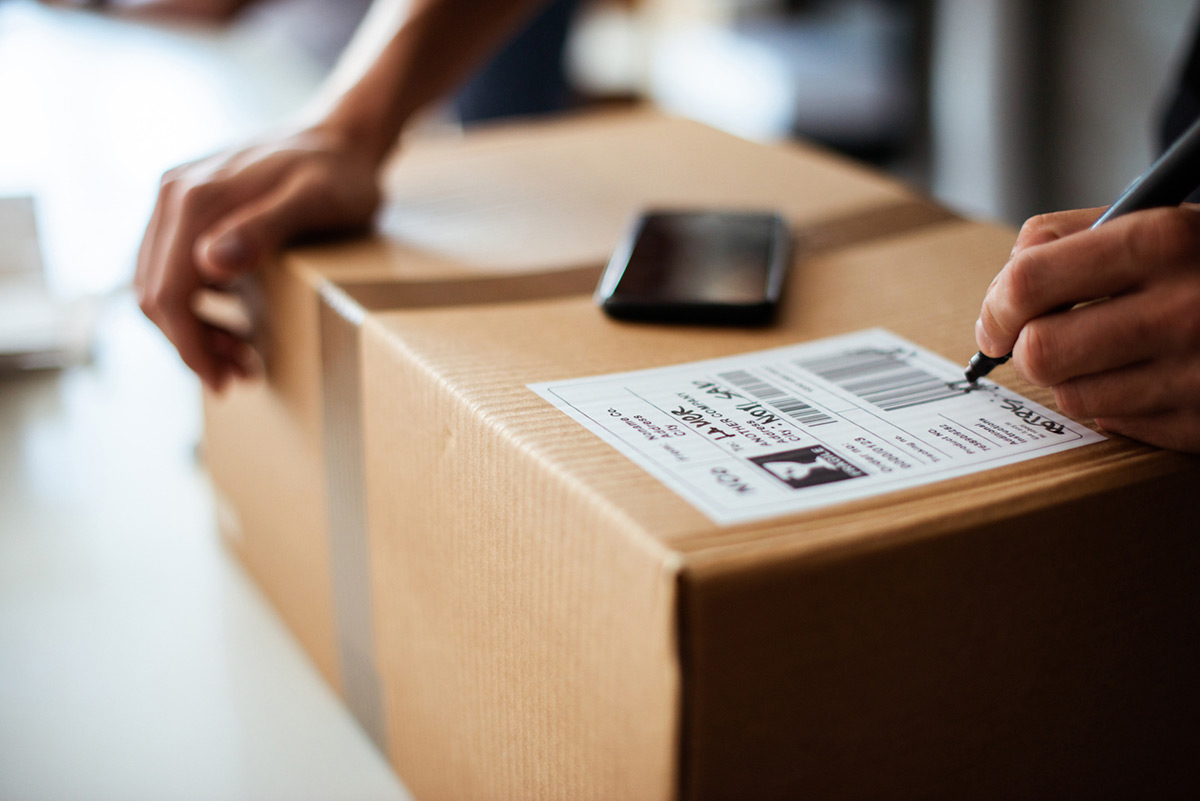
Guide to parcel labelling
To ensure that your parcels arrive safely at their destination, they must be labelled correctly for parcel shipping. This is the only way that shipping service providers such as DHL, Hermes and Co. can read the address label and deliver the parcel on time. Correct labelling prevents delivery delays, returns and additional costs.
An incorrectly labelled parcel costs time, money and customer satisfaction in everyday business. This guide shows you how to do it right – manually and automatically. And we show you how professional labelling with a shipping platform solves all your problems at once.
Correctly labelling parcels: How to place the sender and recipient
The golden rule for manually labelling parcels: The recipient’s address should be large and centrally located on the largest surface of the parcel, while the sender’s address should be smaller and located in the top left-hand corner.
Why is this?
Automatic sorting systems in parcel centres use cameras, scanners and conveyor belts to assign each parcel to the correct destination region as quickly as possible.
If the recipient’s address is large and centrally located on the largest surface, it can be easily recognised and automatically read by the optical scanner. The system links this information to the correct destination so that the parcel is automatically forwarded in the right direction via conveyor belts and switches.
The sender address, on the other hand, is only relevant in exceptional cases (e.g. for returns or undeliverable items). It should therefore be smaller and located in the top left-hand corner so that the scanner does not confuse it with the recipient’s address. Incorrect placement or poor legibility can result in the parcel being processed manually or sorted incorrectly, causing delays.
How should shipping labels not be applied?
- Do not stick over edges or corners – the label must lie on a smooth, flat surface so that scanners can read it completely.
- Do not stick on adhesive tape or foil – shiny surfaces can cause reflections that make barcodes unreadable.
- Do not stick over old labels or barcodes – old information can be recognised by the scanner and lead to incorrect sorting.
- Do not print too small or too large – the label should be in standard format (e.g. A6) so that the QR code can be read correctly.
- Do not attach to the side or bottom of the parcel – the label should be centred on the largest, flattest surface.
- Do not stick on labels that are damaged, smudged or creased – a clean, undamaged label is a prerequisite for machine scanning.
- Do not stick labels too close to the edges of the parcel – keep a minimum 2 cm distance from the edge to avoid damage.
How do I fill out shipping labels correctly?
On the pre-printed shipping label, you will find fields for all relevant data and the necessary address fields. If the parcel label is filled out correctly, you will automatically meet all requirements for the parcel to arrive safely at its destination. These include:
- Name of the recipient (and company name, if applicable)
- Current recipient address including postcode
- Additional shipping details (e.g. destination country, telephone number)
- Correct sender name and address
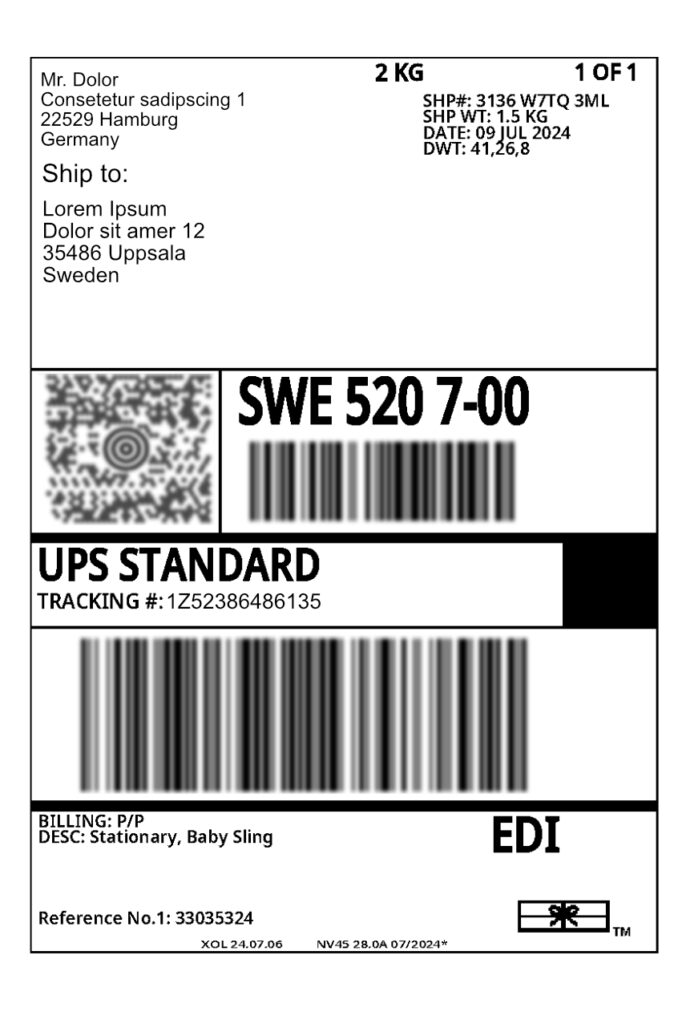
How do you label a parcel correctly? Manual vs. professional shipping label
| Criterion | Parcel labelled correctly by hand | Professional, printed shipping labels |
|---|---|---|
| Area of application | Suitable for private individual shipments or occasional parcels, e.g. among friends or family. | Standard in commercial shipping and for regular shipments – ideal for businesses and online retailers. |
| Legibility | Depends on handwriting and the pen used – often difficult to recognise by machine. | Clear printing, standardised font sizes, fully machine-readable. |
| Information contained | Only manually entered data; no barcodes or QR codes. | Automatically generated data: recipient address, sender, tracking barcode, routing information. |
| Error susceptibility | High – incorrect or illegible information can easily lead to delivery errors or returns. | Low – digital capture reduces address errors and enables automatic sorting. |
| Professionalism | Appears unstructured or unprofessional, especially in a B2B context. | Conveys professionalism and reliability, strengthens brand image. |
| Process reliability | No integration into shipping or ERP systems; manual tracking required. | Fully digitally integrated – shipping data, tracking and invoicing automated. |
| Speed in the shipping hub | Manual checking required, no automatic allocation. | Automatic recognition and sorting using barcodes and scanners – faster delivery. |
| Traceability (tracking) | Not possible – recipient cannot track shipment digitally. | Real-time tracking via QR code or shipment number to the shipping address throughout the entire journey. |
| Sustainability | Can be done on plain paper, but often labelled multiple times or discarded. | Efficient use of resources through digital data and clear print formats. |
Conclusion for B2B companies:
While hand-labelled parcels may be sufficient in exceptional cases, printed shipping labels are the standard for professional shipping. They ensure faster processes, lower error rates and a professional image – crucial for customer satisfaction and efficiency in logistics.
Instructions for parcel services using DHL as an example
The basic principles for labelling (recipient in large print, sender in small print) are universal and generally apply to all other shipping service providers, including UPS, FedEx and DPD.
Labelling DHL parcels
A DHL parcel label sticker for parcels and small packages is available free of charge at most post offices. Fill out the labels, ideally in block letters, and stick them on the top of your parcel. Alternatively, DHL also offers the option of downloading the shipping label directly as a PDF and printing it out. Below is a brief overview of the advantages and disadvantages of the labelling options:
Online franking & online parcel labels (print label)
- The shipping label is created digitally – e.g. via a shipping service provider’s customer portal or shipping software.
- You pay online, receive the parcel label as a PDF to download and print the labels yourself.
- Advantage: Faster, cheaper and automated – address data is recorded digitally and barcodes are immediately machine-readable.
- Ideal for regular or B2B shipments, as data can be easily reused and processes integrated.
Store purchase (parcel label on site)
- The shipping label is created for private customers at a post office or parcel shop.
- You write the recipient and sender details by hand in block letters on the label or have them entered by an employee.
- Advantage: No printer required, personal advice available.
- Disadvantage: Slower and usually more expensive, as the process is manual and no digital tracking is available in advance.
In short: Online franking stands for digital, automated shipping processing, while branch purchase is more manual and traditional – suitable for occasional, not regular business shipments.
Special cases for parcel labelling: labelling small and large parcels correctly for international shipping
Labelling small parcels or packages
For very small parcels or packages, the space available for the shipping label is limited. To ensure that the shipment can still be processed smoothly by automatic sorting systems, all address elements and barcodes must fit completely on a single, smooth surface. Important:
- The label must not be creased or stuck over edges – creased barcodes are often no longer machine-readable.
- If necessary, choose a compact label format (e.g. DIN A6) or adjust the packaging.
- Ensure that the surface is free of adhesive residue or old labels, as these impair scannability.
For B2B shippers, the following applies: for very small shipments that are sent regularly, it is often worth using label-friendly shipping packaging or mini delivery note pockets to increase process reliability.
Sending and labelling large parcels
When it comes to large parcel delivery, the challenge is less about space and more about the visibility and correct positioning of the shipping label. Due to their size, parcels can be processed differently in sorting facilities – therefore, the label should be clearly visible and not covered by banderoles, straps or adhesive tape.
Recommendations:
- Stick the label centrally on the largest, flattest side.
- No foil, straps or strapping should cover the barcode.
- If the parcel has many potential surfaces (e.g. large, flat boxes), ensure that only one side carries the complete address and label information to avoid confusion.
- For very large shipments with pallet binding, an additional label pocket on the long side is recommended so that scanners can capture the label from different angles.
Labelling parcels for international shipping
International shipping places special demands on correct labelling, as parcels pass through several national sorting systems and also pass through customs stations. Accurate and standardised labelling ensures that the shipment is processed correctly worldwide.
B2B shippers should pay particular attention to the following:
- Always indicate the destination country in CAPITAL LETTERS and in English, e.g.:“FRANCE”, “UNITED STATES”, “GERMANY”. This facilitates sorting in international distribution centres.
- Take into account the address format and regional characteristics of the destination country (provinces, states, postcode formats).
- Complete customs documents (e.g. CN22, CN23 or commercial invoices) fully and correctly and attach them to a visible document pocket on the outside.
- The contents must be accurately described, especially in the case of commercial goods.
- Tracking and digital shipping labels are particularly important abroad, as they enable automated customs pre-declaration and seamless shipment tracking. No more mistakes: create shipping labels for all shipping providers (carriers) centrally with LetMeShip.
In our blog article Packaging parcels, we give tips on how to pack parcels securely for long journeys.
No more mistakes: create shipping labels for all providers centrally with LetMeShip
The B2B solution on the all-in-one platform: Instead of writing manually or creating labels on different portals, the labels are provided directly on the platform after you make your booking, regardless of which carrier you have booked. You will also receive this as an attachment in the confirmation email.
Advantages of creating shipping labels with LetMeShip:
- Enter your address details once and receive the appropriate label for each provider.
- Automatic creation of correct, machine-readable labels.
- Integrated address book function to avoid errors.
- Archiving of all shipments and labels in one place.

Hi, I’m Eike 👋
I’m in the LetMeShip Sales team and ready to get the best rates and shipping options for you.
Let’s talk – We’re Here to Help!
Get a call back or book an appointment at your convenience.
FAQ
Questions and answers about labelling parcels correctly
Does the sender have to be on the parcel?
Yes, in commercial shipping, the sender should always be indicated on the package. Even though many shipping service providers do not make this mandatory, the sender address is crucial for a smooth and traceable shipping process in a B2B context.
Why is the sender important?
- Returns & undeliverability: If a package cannot be delivered, the sender address enables automatic return without any loss of time.
- Transparency for business customers: Recipients can immediately see which company the shipment comes from – important for supply chains, goods receipt, and QA processes.
- Complaints and service cases: Clear sender information facilitates communication and tracking.
- Legal requirements: In certain industries (e.g., spare parts, high-value goods), the sender is required for documentation purposes anyway.
Can I simply stick over an old shipping label?
No, old shipping labels must not be stuck over or remain visible. Scanners in sorting centers can recognize old barcodes or addresses, leading to misrouting or returns.
Best practice for companies:
- Completely remove old labels or cover them with an opaque, non-reflective surface.
- This is especially important when reusing reusable packaging or boxes from returns.
What do I write on the package for a c/o address?
A c/o address (“care of”) is used when the actual recipient receives the shipment at another person’s or company’s address.
Recommended format:
- Name of the actual recipient
- c/o + name of the person or company receiving the shipment
- Street, house number
- ZIP code, city
In a business environment, the c/o information ensures that the shipment is forwarded correctly within larger buildings, companies, or associations.
Which pen should I use to label a package by hand?
For handwritten labels—such as for emergency or private shipments—it is essential to use a waterproof, strong felt-tip pen or marker.
Important:
- Dark, strong color (black or dark blue)
- Easily legible block letters
- No ballpoint pens or light colors – they are difficult to read, especially on cardboard.
- In B2B shipping, however, hand labeling should only occur in exceptional cases.
My printer prints the DHL label too small – what should I do?
The most common cause is automatic scaling in the print dialog.
Here’s how to ensure that the label is printed correctly:
- Set scaling to 100% in the print menu
- Deactivate “Fit to page”
- Check whether the format is set to DIN A6 or original size
- A correctly scaled label ensures that barcodes are fully legible and can be processed cleanly by machines.
What should be considered when providing a foreign address?
When shipping internationally, there are a few formal points that are particularly important:
- Always write the recipient country in CAPITAL LETTERS below the address (e.g., GERMANY).
- Observe the address format of the destination country (differences in postal code systems, provinces, regions).
- Add the recipient’s phone number – often required for customs or delivery queries.
- For non-EU countries: Fill out the customs declaration (CN22/CN23) correctly and attach it visibly to the package.
- Use printed labels so that international sorting centers can process the data in a machine-readable format.
What should be considered when packing parcels?
We organize the shipping of your parcels of all sizes and for every need. In addition to correct labeling, the choice of packaging is also crucial for safe transport. In our blog article Packing parcels securely, we provide tips for safe packaging.