Mercosur Agreement: New opportunities for trade with South America – and what this means in terms of shipping and logistics.

Apr 10, 2026
8 min.
Article last updated on 9 October 2026
The Key Facts about the EU-Mercosur Trade Agreement
The EU-Mercosur Agreement removes tariffs between the EU and Brazil, Argentina, Paraguay and Uruguay from May 2026. Exporters benefit from lower duties but must compare carriers carefully, as shipping costs vary significantly by destination.
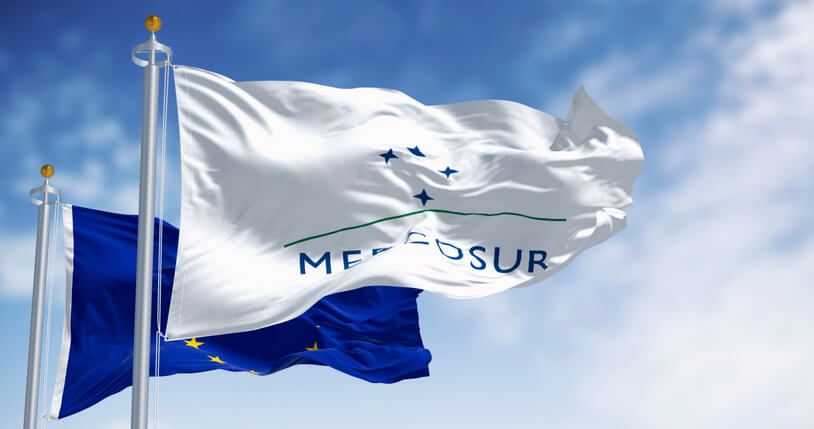
The is about to come into force and ranks among the most significant EU trade agreements of recent years. For German companies – particularly in export and logistics – the EU-Mercosur trade agreement opens up enormous opportunities, but also brings new challenges. Those who are prepared now can secure decisive competitive advantages.
What does the Mercosur Agreement mean specifically for shipping?
The Mercosur Agreement is a planned EU-Mercosur Free Trade Agreement between the European Union and the Mercosur countries (Brazil, Argentina, Paraguay and Uruguay). The aim is to remove tariffs and trade barriers. The agreement is expected to come into force on 1 May 2026 and will have a major impact on exports, shipping costs and international supply chains.
But what does this actually mean for businesses in their day-to-day operations – particularly for shipping and logistics? A quick look at typical shipping costs reveals where the greatest opportunities for savings lie.
Status of the Agreement
The EU–Mercosur Agreement has been provisionally applied since 1 May 2026. Poland has, however, lodged an urgent application with the Court of Justice of the European Union. On 29 September 2026, the Vice-President of the Court of Justice rejected this application: provisional application will not be suspended for the time being. The main proceedings concerning Poland’s action are still pending.
Practical example: Shipping costs to Mercosur countries
Although many tariffs will be reduced when the Mercosur Agreement comes into force, the actual shipping costs remain a decisive factor for exporters. A multi-carrier comparison shows that prices, transit times and services vary considerably depending on the destination country. This is precisely where there is significant potential for optimisation.
| from → to | Carrier | Service | Transit time | Example price* |
|---|---|---|---|---|
| 🇩🇪 → 🇧🇷 Berlin → Brasília | DHL Express | Express Worldwide | 3-4 days | from 163 € |
| 🇩🇪 → 🇧🇷 Berlin → Brasília | UPS | Express Saver | 3-4 days | from 141 € |
| 🇩🇪 → 🇧🇷 Berlin → Brasília | FedEx | Economy | 3-4 days | from 203 € |
| 🇩🇪 → 🇦🇷 Berlin → Buenos Aires | UPS | Express Save | 3-4 days | from 151 € |
| 🇩🇪 → 🇦🇷 Berlin → Buenos Aires | FedEx | Economy | 3-4 days | from 203 € |
| 🇩🇪 → 🇦🇷 Berlin → Buenos Aires | FedEx | International Priority | 3-4 days | from 286 € |
| 🇩🇪 → 🇵🇾 Berlin → Asuncion | DHL Express | Express Worldwide | 4–7 days | from 163 € |
| 🇩🇪 → 🇵🇾 Berlin → Asuncion | FedEx | Economy | 4–7 days | from 203 € |
| 🇩🇪 → 🇺🇾 Berlin → Montevideo | DHL Express | Express Worldwide | 4–7 days | from 163 € |
| 🇩🇪 → 🇺🇾 Berlin → Montevideo | FedEx | Economy | 4–7 days | from 203 € |
*Prices vary depending on weight, dimensions and daily rates. Sample calculation for a 2kg parcel from Berlin, Germany to the respective capital of the Mercosur country.
Context: What does this mean in practice for exporters?
The example prices clearly show that, in addition to customs duties, it is primarily the choice of carrier, service level and target market that determine the actual shipping costs.
For companies exporting to the Mercosur region for the first time in particular, it is therefore worth taking a close look at the available options and processes.
Which carriers are particularly recommended for Brazil?
For shipments to Brazil – the most important Mercosur market – the following have proven particularly reliable:
- DHL Express WW → best customs integration & high delivery rate
- UPS Saver → attractive prices for standard express
- FedEx Economy → very reliable in the B2B sector
These differences are particularly relevant for regular shipments or time-critical deliveries.
How LetMeShip simplifies customs clearance
Customs can be particularly complex in Mercosur countries. LetMeShip significantly reduces this effort:
- Automatic creation of shipping documents
- Support with commercial invoices & customs declarations
- Clear overview of customs duties and requirements
- Integration of leading express carriers
This helps in particular to avoid typical errors and reduce delays.
Tips for preparing shipments for the Mercosur region
To ensure your shipment arrives smoothly:
- Documentation
– Complete commercial invoice (in English or the local language)
– Clear description of goods (no generic terms) - Customs declarations
– Use correct HS codes
– State a realistic value of goods - Packaging
– Pack securely (long transport routes)
– Suitable for air freight (note volume weight)
These factors are becoming increasingly important, particularly in the context of new trade agreements, as rising shipping volumes also increase the demands on processes.
What is changing regarding customs duties and trade barriers?
In addition to the operational aspects of shipping, it is worth taking a look at the regulatory changes brought about by the agreement.
A key objective of the EU-Mercosur Free Trade Agreement is the reduction of Mercosur customs duties.
In concrete terms, this means: Up to 90% of tariffs will be abolished in the long term.
This particularly affects the following product groups:
- Mechanical engineering
- Automotive
- Chemical products
- Consumer goods
Example:
In future, a German exporter will be able to deliver products to Brazil at significantly lower costs – which massively increases competitiveness.
At the same time, new requirements arise regarding:
- Rules of origin
- Customs clearance
- Documentation
Result: Products from the EU will become significantly more competitive in South America.
Impact on shipping to South America
The changes to tariffs and market access have a direct impact on logistics. The Mercosur Agreement will significantly alter international shipping to some South American countries.
Opportunities:
- Rising export volumes
- New markets for SMEs
- Faster customs processes
Challenges:
- Complex customs requirements (transition phase)
- Infrastructure differences
- Rising demand → capacity bottlenecks
Mercosur Agreement: Pros and cons for exporters
In addition to the operational implications, a strategic assessment is worthwhile.
Advantages:
- Elimination of tariffs → lower costs
- Better market access in South America
- Competitive advantages over non-EU suppliers
- Growth potential for exports and e-commerce
Disadvanteges:
- Bureaucratic adjustments required
- Different standards and regulations
- Currency risks and political uncertainties
What does the agreement mean for logistics?
For logistics and shipping, the agreement means one thing above all: the increasing importance of international supply chains.
The EU-Mercosur Trade Agreement is bringing about lasting changes to logistics.
New requirements:
- Adapt customs processes
- Optimise international supply chains
- Expand routes to South America
New opportunities:
- Growth in international shipping
- New business areas (e.g. cross-border e-commerce)
- Strategic partnerships in South America (expansion)
Conclusion
The EU-Mercosur trade agreement is more than just a political project – it is a concrete opportunity for European companies to tap into new markets.
At the same time, it is clear that, alongside regulatory advantages, operational factors such as shipping costs, carrier selection and customs processes remain crucial to export success. Those who prepare now can secure decisive competitive advantages.
Create a free customer account now, calculate shipping costs to South America and tap into new markets. Ship quickly, transparently and internationally with LetMeShip.
FAQ
Frequently asked questions about the Mercosur Agreement
What is the Mercosur Agreement?
The Mercosur Agreement (also known as the EU-Mercosur Trade Agreement) is one of the largest planned EU trade agreements in the world. It links two major economic blocs:
- The European Union (EU)
- The South American confederation Mercosur
The aim of the agreement is to remove trade barriers, in particular:
- Tariffs on goods
- Bureaucratic hurdles
- Regulatory differences
For businesses, this means: easier market access and lower costs in the export business.
Which countries belong to Mercosur?
The main Mercosur countries are:
- Brazil
- Argentina
- Paraguay
- Uruguay
These markets are particularly relevant for German exporters – above all Brazil as the largest trading partner.
Associated states (with limited rights) include:
- Chile
- Bolivia (accession process ongoing)
Particularly relevant for exporters: Brazil and Argentina are the region’s largest markets.
When will the EU-Mercosur Agreement come into force?
Current status (EU-Mercosur update):
- Political agreement: concluded
- Ratification: well advanced
- Entry into force: expected 1 May 2026
Important: Businesses should adapt their export and logistics strategies now.
What does the abolition of Mercosur tariffs mean?
The abolition of Mercosur tariffs means that many goods can be exported more cheaply – a major advantage for European companies.
Mercosur Agreement: Pros and cons?
Pros: Lower costs, new markets, growth
Cons: Red tape, political risks, criticism of environmental standards
Has the Mercosur agreement failed?
No. Despite political debate, the agreement has been finalised and is about to come into force.
What impact will the Mercosur Agreement have on businesses?
It facilitates the export of goods, reduces costs and creates new business opportunities – particularly in the B2B sector.
How will the agreement affect exports from the EU?
Exports from the EU to the Mercosur countries are expected to rise significantly – particularly in manufacturing, engineering and consumer goods.
Which products will benefit from the EU-Mercosur trade agreement?
The Mercosur Agreement will primarily benefit export-oriented industries in the EU, as many tariffs will be phased out. These include, in particular:
- Machinery and equipment
- Vehicles and car parts
- Chemical products
- Pharmaceutical products
- Consumer goods (e.g. electronics, textiles)
For businesses, this means: significantly lower export prices and improved competitive opportunities in South America.
Which markets are particularly relevant for exporters?
The most important target markets under the EU-Mercosur Trade Agreement are:
- Brazil – the largest market with high demand and a well-developed infrastructure
- Argentina – an important industrial hub with growing import demand
- Uruguay & Paraguay – smaller but strategically interesting markets with less competition
Brazil in particular is regarded as a key market for entering the Mercosur region and offers the greatest growth potential for exporters.