At a glance
HS codes, in short
An HS code is an internationally standardised number used to classify a product for customs purposes. The first six digits are the same in more than 200 countries; from there, individual countries and regions — including the EU with its TARIC code — add further digits for their own tariff and statistics needs.
Our HS Code Finder above suggests a starting code from a plain description of your product; the sections below explain how the code is structured, how to find it yourself using official databases, and where to go if you’d rather get a binding answer or estimate the import duty it triggers.
26 years
of logistics expertise paired with dedicated customer service.
3 million
consignments sent over our shipping platform every year.
90 seconds
the time it takes you from login to retrieving your shipping label.
Found your HS code? Book your shipment now
You have your code — now take the next step. Compare shipping rates, pick the carrier that suits the job, and book your consignment including customs handling. In one place, with no contract.
Calculate your shipping costs









What is an HS code — and why does it matter for shipping?
The Harmonized System (HS) is a standardised numerical method of classifying traded products, maintained by the World Customs Organization. Every product moving across a border — from a T-shirt to an industrial pump — has a corresponding HS code, and customs authorities use it for three things: calculating the import duty owed, checking whether the goods are subject to specific trade rules or restrictions, and assessing risk.
Get the code wrong, and the consequences follow directly: the wrong duty rate may be applied, the shipment can be delayed for reclassification, or — in the case of a deliberately incorrect code — you may face penalties. That makes the HS code one of the first things to get right, before duty, VAT or clearance costs are even calculated. For a full breakdown of the customs guide and how these pieces fit together, see our customs overview; the shipping glossary also has a short definition entry.
HS code vs. commodity code vs. TARIC code — what’s the difference?
The terms are often used interchangeably, but they describe three different levels of precision.
HS code
The Harmonized System code is the globally uniform standard: six digits, defined and maintained by the World Customs Organization, and used in more than 200 countries. This is the level at which products are consistently classified worldwide.
Commodity code (customs tariff number)
Countries extend the six-digit HS code with additional digits for their own tariff and statistics purposes. In the EU, export declarations use an eight-digit code; import declarations use a ten- or eleven-digit code, known as the TARIC code. The extra digits determine the concrete duty rate, taxes and any specific regulations that apply.
TARIC code (EU)
The EU’s own ten-digit extension (the eight-digit code plus two further digits), which captures EU-specific measures such as anti-dumping duties, quotas or preferential rates. It’s the level of detail EU customs authorities actually check against when goods are imported — see the German customs tariff guidance for how this works in practice.
In short: the HS code is the worldwide foundation, the commodity code adds a country’s own detail, and the TARIC code is the EU’s specific ten-digit version of that detail. Getting the code right is only half the picture — who actually pays the duty and VAT it triggers, and who is responsible for customs formalities, is a separate question, settled by the Incoterms agreed for the shipment.
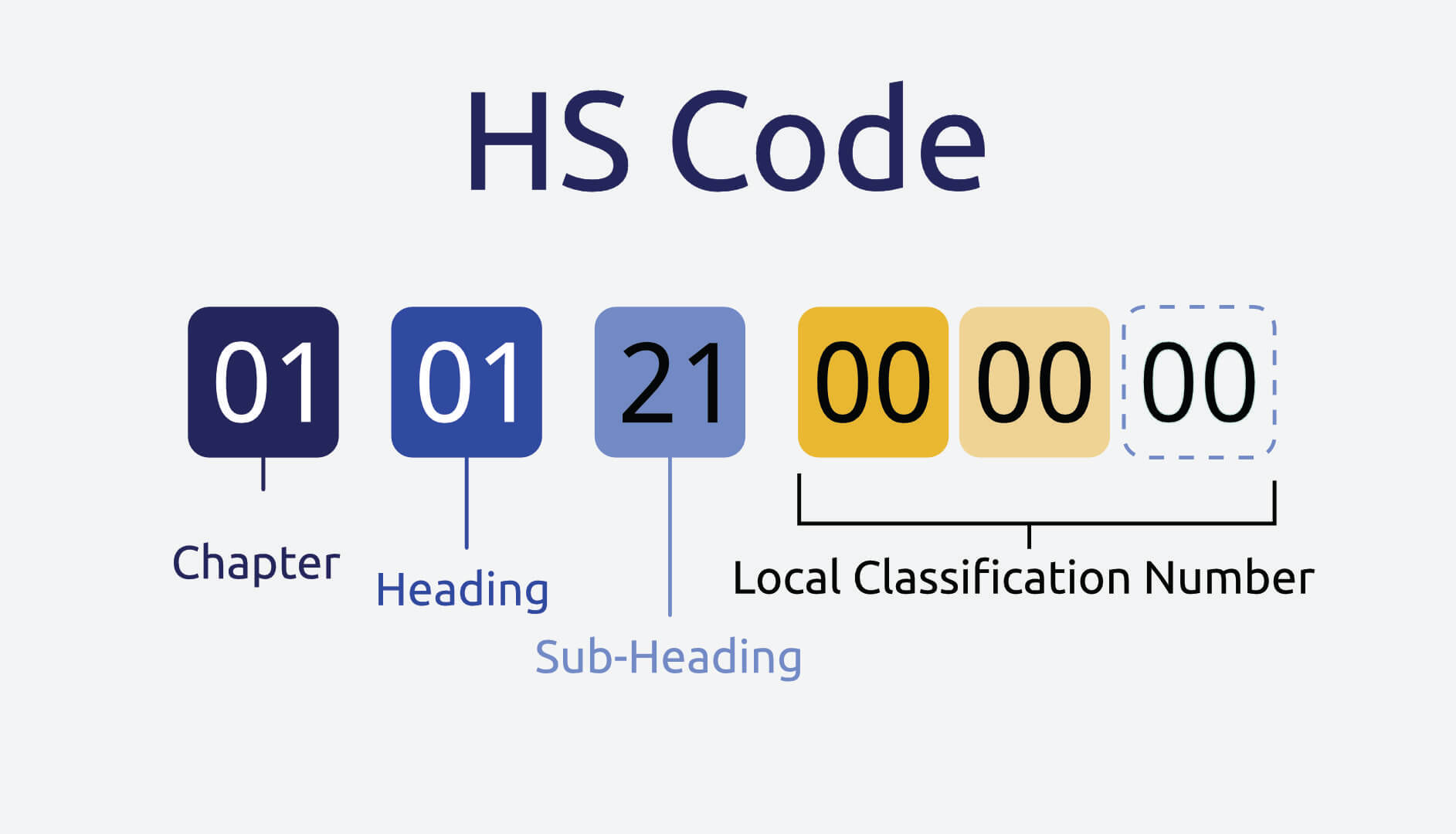
How an HS code is structured
Take 6109.10 — cotton T-shirts — as an example:
| Digits | Meaning | Example value |
|---|---|---|
| 61 | Chapter — broad product category | Articles of apparel and clothing accessories, knitted or crocheted |
| 09 | Heading — product group within the chapter | T-shirts, singlets and other vests |
| 10 | Subheading — material or further specification | Of cotton |
The first six digits (61.09.10) are identical wherever the product is classified in the world. Beyond that, individual countries or trading blocs add further digits — in the EU, up to ten for imports (the TARIC code), giving the additional precision customs authorities need to apply the correct duty rate and any specific measures.
How to find your HS code — step by step
Import duty on shipments to the USA has changed considerably across many product categories, in some cases sharply. And since Brexit, shipping to the UK brings its own customs requirements. An imprecise or incorrect code can mean:
- Describe the product precisely. Include what it’s made of, what it’s used for and how it’s presented (loose, packaged, as a set). A vague description is the most common reason an HS code ends up wrong — see the mistakes below.
- Try the HS Code Finder above. Type in your product description and get a suggested starting code in seconds — useful as a first orientation before checking the official databases.
- Confirm the code in an official tariff database. For the EU, the TARIC database lets you search by product description or browse by category and returns the applicable customs tariff number for your destination market — the authoritative source for any classification you’ll actually declare.
- Check your supplier’s documentation. The code is often already stated on the commercial invoice, sometimes labelled “customs code“. As the shipper, you remain responsible for the correct classification even if you’re relying on a supplier’s figure — always verify it independently.
- Save confirmed codes for repeat shipments. If you ship the same product line regularly, record the confirmed code once rather than reclassifying it from scratch every time — LetMeShip stores codes against your shipment history for exactly this reason.
- If in doubt, ask. For anything unclear, our support team can help you work through the classification, or you can apply for a Binding Tariff Information (BTI) ruling (see below) for full legal certainty.
Common HS code mistakes to avoid
- Vague product descriptions. “Plastic parts” or “electronic device” isn’t specific enough — the classification depends on exact material, function and composition.
- Outdated codes. HS codes are revised roughly every five years by the World Customs Organization; a code that was correct three revisions ago may no longer apply.
- Leaving the code out entirely. A missing HS code is one of the most common causes of delays at customs — the shipment is held until it can be classified manually.
- Deliberately misclassifying goods to reduce duty. Beyond the ethical issue, this can result in penalties, back payments and repeated customs scrutiny of future shipments.
Binding Tariff Information (BTI) — for extra certainty
If you need full legal certainty rather than a starting suggestion, you can apply for Binding Tariff Information (BTI) — an official, written ruling from a customs authority confirming the correct HS code for your specific product. A BTI is issued through the EU Customs Trader Portal, is valid across the entire EU, and typically holds for around three years. It’s a formal process best suited to products you ship repeatedly at volume or where the classification is genuinely ambiguous — not something needed for every shipment.
From code to shipment: estimate your customs costs
Once you have a confirmed HS code, the next question is usually what it will cost to bring the goods across the border. Our import duty calculator uses the same kind of plain-description input to estimate import duty, import VAT and likely customs clearance costs — the code you’ve just found is exactly what that estimate is based on. From there, you can compare shipping costs across carriers and book your shipment with the customs paperwork already in hand.
Real shipping experts — talk to a person, not just the tool
An HS code suggestion is a starting point, not a substitute for judgement on genuinely ambiguous products. If you’re unsure — or shipping something classification-sensitive at volume — our support team can talk it through with you directly. That’s consistent with how LetMeShip works more broadly: personal service throughout the shipping process, not just at the point of booking.

Hi, I’m Eike 👋
I’m in the LetMeShip Sales team and ready to get the best rates and shipping options for you.
Let’s talk – We’re Here to Help!
Get a call back or book an appointment at your convenience.
FAQ
Frequently asked questions about the HS Code Finder
How do I find the HS code of a product?
Describe the product’s material, function and use as precisely as possible, then check it against an official tariff database such as TARIC for the EU. Our HS Code Finder above can suggest a starting code from your description.
How can I find my HS code?
Use a description-based tool like the HS Code Finder above, or search directly by product category in an official database such as TARIC. Supplier invoices often already state a customs code you can cross-check.
How do I find the HS code for an item?
Enter a precise description — material, use and presentation — into the HS Code Finder or an official tariff database. The more specific the description, the more accurate the suggested classification.
How do I find the right HS code for my product?
Start with a precise product description, confirm it against an official database for your destination market, and check your supplier’s paperwork. For genuinely ambiguous products, apply for a Binding Tariff Information ruling for a legally certain answer.
How can I find the HS code for my product?
The fastest route is a description-based finder tool, followed by confirmation in an official customs tariff database such as TARIC. Keep the confirmed code on file if you ship the same product again.
How do I find my HS number?
“HS number” and “HS code” refer to the same thing — the internationally standardised classification number. Find it the same way: precise product description, checked against an official tariff database.
How do I check a HS code?
Enter the code into an official database such as TARIC to see the description it corresponds to and confirm it matches your product, including the applicable duty rate and any specific restrictions.
Is an HS code the same in every country?
he first six digits are identical worldwide. Beyond that, countries and trading blocs add further digits — up to ten for EU imports — for their own tariff and statistics purposes, so the full code can differ by destination even when the first six digits match.
What happens if I use the wrong HS code?
A wrong HS code can lead to delays while customs reclassifies the shipment, an incorrect duty amount (over- or underpaid), or — if the misclassification looks deliberate — penalties and closer scrutiny of future shipments.