






explained briefly
Incoterms at a glance: definition and all 11 clauses
What are Incoterms? Incoterms (International Commercial Terms) are standardised, globally recognised rules published by the International Chamber of Commerce (ICC). In international trade, they set out how responsibilities are divided between buyer and seller. Specifically, they define who covers the transport costs, who’s liable for loss or damage (risk transfer), and who’s responsible for customs clearance and obtaining the necessary customs documents.
There are currently 11 Incoterms clauses, split between rules for any mode of transport (multimodal) and clauses reserved for sea freight only. On modern B2B shipping platforms like LetMeShip, the default focus is on the two most important all-purpose clauses: DAP and DDP.
Incoterms meaning and relevance in B2B foreign trade
In B2B foreign trade, agreeing precise delivery terms can make or break the financial outcome of a deal. Misunderstandings over transport conditions can, in the worst case, lead to significant extra costs, customs shipments stuck at the border, or unresolved liability disputes over transport damage.
Incoterms 2020 provides a clear framework that heads off exactly these problems. In day-to-day logistics, though, most road, express and air freight shipments can be handled most safely and efficiently under just two central clauses: DAP and DDP. Through our platform, you manage both your goods exports and your goods imports under these clauses fully digitally and with full legal certainty.
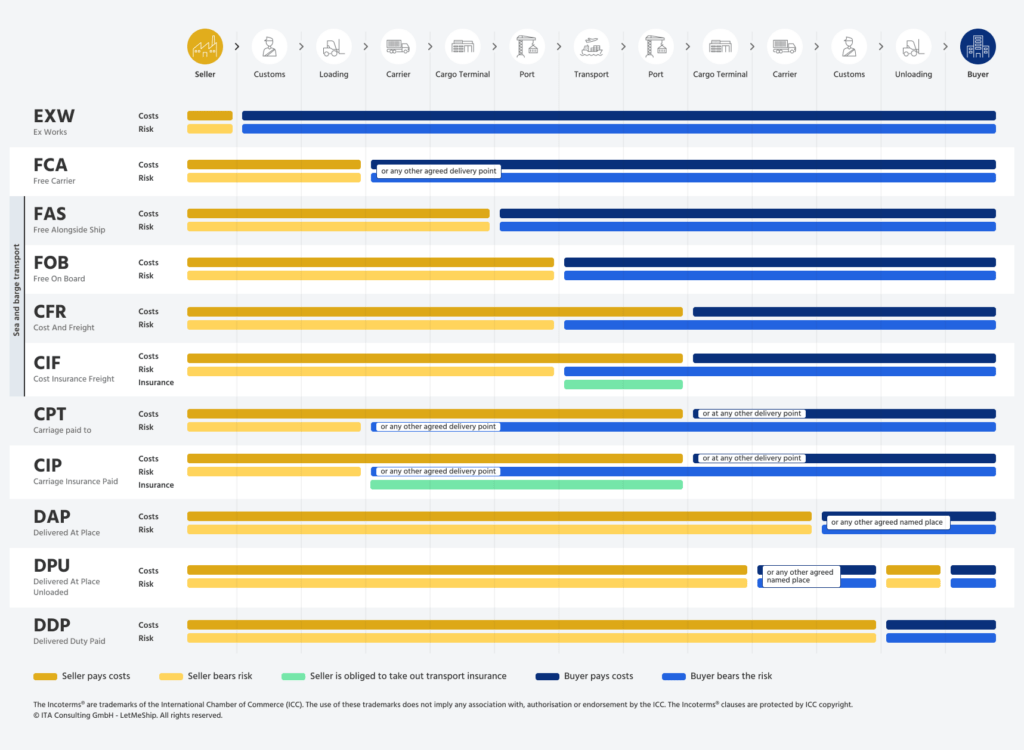
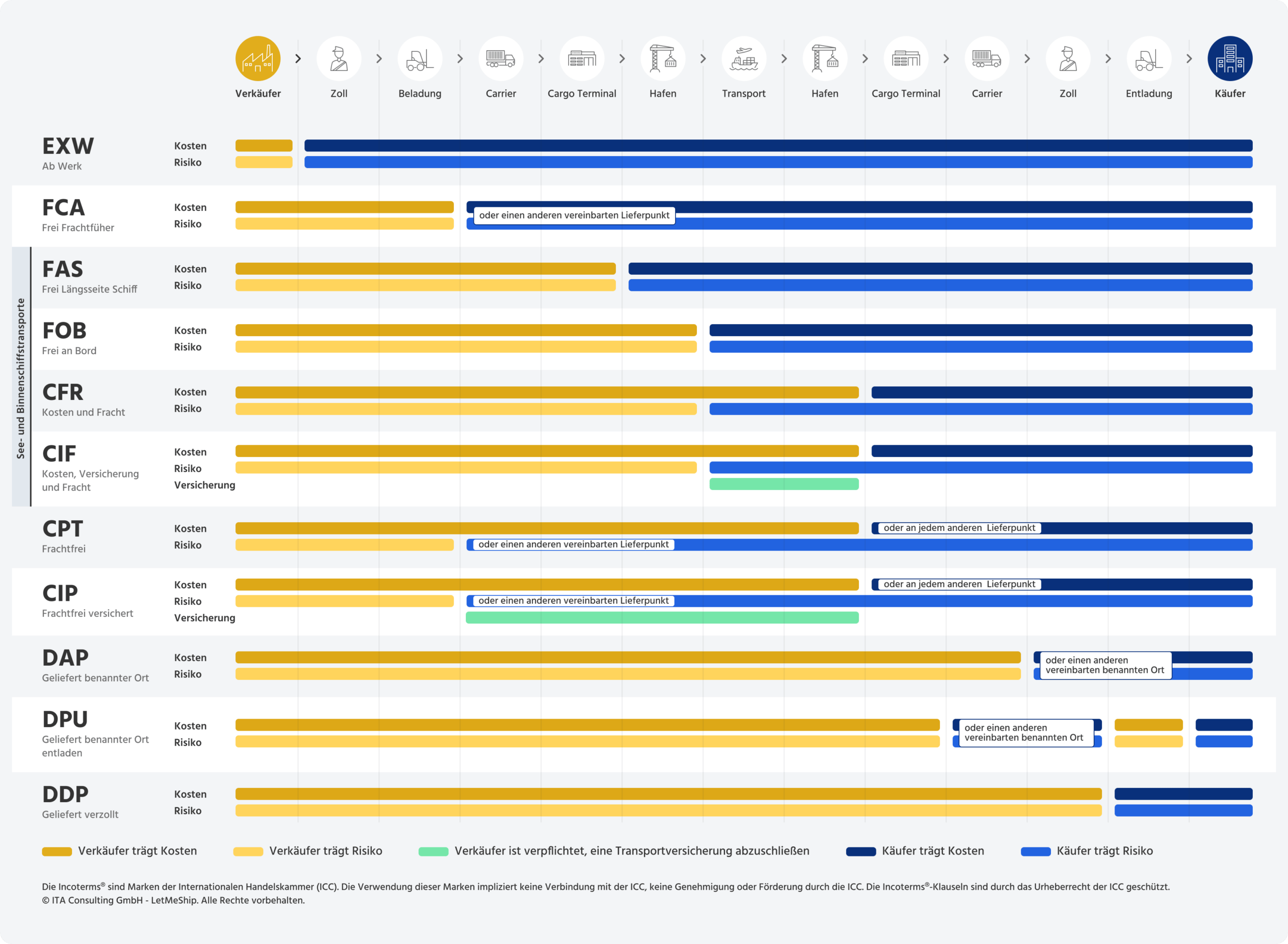
All 11 Incoterms 2020 clauses at a glance
The table below gives you a quick point of reference for every clause currently in force. It also covers the DAP terms under Incoterms in more detail than a typical summary table, since these are the clauses most B2B shippers actually need day to day.
The following table provides a quick overview of all currently valid clauses:
Overview: risk transfer and cost split
| Clause | Full Term | Risk Transfer | Seller’s costs covered until … |
|---|---|---|---|
| DAP | Delivered At Place | Goods made available for unloading at the named destination (not customs-cleared or duty-paid). | Named destination (excluding import clearance/duties/taxes). |
| DDP | Delivered Duty Paid | Goods made available for unloading at the named destination (customs-cleared and duty-paid). | Named destination (including import clearance, duties and taxes). |
| FCA | Free Carrier | Handover to the carrier nominated by the buyer, at the named place. | Named place of handover (including export clearance). |
| EXW | Ex Works | On collection of the goods at the named place (usually the seller’s works/warehouse). | Named place of collection (seller does not load the goods). |
| CPT | Carriage Paid To | Handover of the goods to the first carrier. | Named destination (main carriage paid). |
| CIP | Carriage and Insurance Paid To | Handover of the goods to the first carrier. | Named destination (main carriage + all-risk insurance paid). |
| DPU | Delivered at Place Unloaded | After unloading from the arriving means of transport, at the named destination. | Named destination (including unloading, excluding import duty/taxes). |
| FAS | Free Alongside Ship | Placement of the goods alongside the ship at the named port of shipment. | Alongside the ship at the port of shipment. |
| FOB | Free On Board | Once the goods are delivered on board the ship at the named port of shipment. | On board the ship at the port of shipment. |
| CFR | Cost and Freight | Once the goods are delivered on board the ship. | Named port of destination (main sea carriage paid). |
| CIF | Cost, Insurance and Freight | Once the goods are delivered on board the ship. | Named port of destination (main carriage + minimum insurance paid). |
The other clauses in brief (EXW, FCA and co.)
To save you wading through the small print, we’ve summarised the remaining nine clauses as compactly as possible. These play a smaller role in standardised multi-carrier shipping and aren’t offered directly by LetMeShip for standard platform bookings:
- EXW (Ex Works): Minimal obligation for the seller — the buyer collects the goods unloaded and without export clearance in place. *Watch out:* this can expose the seller to tax risk when it comes to proving the goods actually left the country. Also written as exw incoterms or ex works incoterms in most searches.
- FCA (Free Carrier): The seller hands over the export-cleared goods to the buyer’s nominated carrier. A common alternative to EXW in B2B trade, and the clause the ICC now recommends wherever a seller can handle export clearance — which, in practice, is almost always (more on the FCA Incoterms meaning below).
- CPT (Carriage Paid To): The seller pays for the main carriage, but risk passes to the buyer as soon as the goods reach the first carrier. Sometimes searched as carriage paid to incoterms or CPT incoterms.
- CIP (Carriage and Insurance Paid To): Works like CPT, but the seller must also take out all-risk transport insurance.
- DPU (Delivered at Place Unloaded): The seller must deliver the goods to the destination *and* unload them personally. Only after that does risk pass to the buyer.
- Sea-freight-only clauses (FAS, FOB, CFR, CIF): These four terms may only be used for conventional (non-containerised) sea transport. Risk usually passes as soon as the goods are loaded on board the ship. Note: FOB stands for Free On Board — you’ll sometimes see it written as “freight on board incoterms”, but that’s a common mix-up, not the correct term. The same logic applies to CIF incoterms and cost and freight incoterms (CFR).
Focus on DAP & DDP: the B2B clauses LetMeShip offers, in detail
In modern parcel, express and pallet shipping, DAP and DDP have established themselves as the safest and most customer-friendly interfaces between buyer and seller. That’s why we focus on these two clauses at LetMeShip: they give you a clean split of logistics responsibilities and run seamlessly through our multi-carrier platform.
Direct comparison: DAP vs DDP (cost & risk)
| Criterion / process step | DAP (Delivered At Place) | DDP (Delivered Duty Paid) |
|---|---|---|
| Risk transfer (liability for loss/damage) | Seller (liable until the goods are made available at the agreed delivery address) | Seller (liable until the goods are made available at the agreed delivery address) |
| Packing & shipment preparation | Seller (cost & organisation) | Seller (cost & organisation) |
| Export clearance | Seller (prepares the export declaration) | Seller (prepares the export declaration) |
| Main carriage (freight costs) | Seller (pays transport to the destination) | Seller (pays transport to the destination) |
| Import clearance | Buyer (recipient handles the import) | Seller (sender / carrier handles the import) |
| Import duties & customs fees | Buyer (recipient pays any duties) | Seller (sender pays any duties) |
| Import VAT | Buyer (recipient pays import VAT) | Seller (sender pays import VAT) |
| Unloading at destination | Buyer (carrier unloads the vehicle) | Buyer (carrier unloads the vehicle) |
| B2B customer experience | Limited (missing clearance instructions, a power of attorney, or unexpected charges can delay delivery) | Maximum (a missing clearance instruction or power of attorney can still delay delivery) |
*Important: as the comparison shows, liability only shifts to the buyer at the destination under either clause. The real difference lies purely in who covers customs clearance and import duties in the destination country.
1. DAP — Delivered At Place
Under DAP Incoterms, the seller is responsible for the safe transport of the goods all the way to the destination.
- Cost split: The seller pays for packing, export clearance and the entire transport leg to the delivery address. The buyer covers import VAT, duties and the local clearance fee.
- Risk transfer: Risk of loss or damage only passes to the buyer once the goods are made available at the destination on the means of transport (still unloaded). With LetMeShip’s parcel and express carriers, unloading is carried out by the carrier’s driver.
2. DDP — Delivered Duty Paid
The DDP Incoterms clause is the fully-inclusive package for the recipient, and the most customer-friendly shipping method in B2B online trade. It’s also referred to (less precisely) as delivery duty paid Incoterms in some searches.
- Cost split: The seller covers *all* costs involved — freight, export clearance, import duties, import VAT and the destination-country clearance fee. The buyer doesn’t need to do anything beyond taking delivery and unloading.
- Risk transfer: As with DAP, the seller remains liable for the goods until they’re made available at the buyer’s delivery address.
Real-world scenarios: DAP and DDP in everyday B2B shipping
How do these clauses actually play out in your day-to-day logistics? The two scenarios below show them in practice.
Szenario A: spare parts to Switzerland under DAP
Background: A German toolmaker needs to send urgently required spare parts worth €1,500 to a business customer in Zurich, Switzerland.
How it works via LetMeShip:
- The seller logs into LetMeShip, compares rates and books an express service (e.g. FedEx or DHL Express).
- During booking, they select the DAP option (the default setting).
- The seller prepares the commercial invoice and the export declaration.
- The express carrier moves the parcel across the border.
- The express carrier’s customs broker contacts the Swiss recipient, who pays the applicable Swiss VAT and any duties.
- Once payment is received (or via the recipient’s deferred customs account), the parcel is delivered.
Why this works well: the German seller never has to get to grips with Swiss tax law. The tax side of things in the destination country stays entirely with the Swiss recipient.
Szenario B: premium delivery to a US plant under DDP
Background: An electronics manufacturer in Hamburg delivers specialist components directly to a customer’s assembly line in Texas, USA. The US customer wants completely uninterrupted delivery with zero admin on their end.
How it works via LetMeShip:
- The seller selects DDP in the LetMeShip system (also described as “duty/tax paid by the sender”).
- They issue a commercial invoice showing the Incoterm as `DDP Houston, TX, Incoterms® 2020`.
- The express carrier booked through LetMeShip takes care of the entire US import clearance process.
- The parcel is delivered straight to the recipient’s factory gate in Texas — the US customer makes no payments and fills in no forms.
- The resulting US import duties and the clearance fee are billed back to the German seller afterwards by the carrier.
Why this works well: maximum customer satisfaction. The US buyer receives the goods as smoothly as they would a domestic delivery.
Calculate your shipping costs
Risk transfer and cost split: what each clause actually governs
A common misconception is that Incoterms govern the transfer of ownership of goods. That’s wrong — ownership is governed purely by the underlying sales contract. Incoterms only govern:
- Division of duties: Who organises transport and books the carrier? (Always the seller, under both DAP and DDP.)
- Cost transfer: Up to which geographical point does the seller pay for transport? (Excluding import duties under DAP; including them under DDP.)
- Risk transfer: From which point does the seller stop being liable for loss or damage? (Under both DAP and DDP, risk stays with the seller until the destination.)
Why the exact place matters
An Incoterm without an exact place designation is legally worthless. Never write just “DAP” or “DDP” on your documents. The correct wording on a commercial invoice always includes:
- The Incoterm clause
- The precise address of the handover point
- The rules version
Poor example: DAP Switzerland (too vague — where exactly in the country does risk and cost transfer?)
Good example: DAP Industriestrasse 12, CH-8002 Zürich, Incoterms® 2020
Incoterms and customs documents: obligations under DAP & DDP
When exporting to third countries (outside the EU), the choice between DAP and DDP decides who’s responsible for tax and customs matters.
| Process / document step | DAP | DDP |
|---|---|---|
| 1. Commercial invoice | Seller issues the commercial invoice (Incoterm note: DAP [place]) | Seller issues the commercial invoice (Incoterm note: DAP [place]) |
| 2. Export declaration | Seller declares the goods for export (e.g. via the ATLAS system from €1,000 upwards, for German-origin exports) | Seller declares the goods for export (same threshold applies) |
| 3. Main carriage | Seller (or LetMeShip/carrier) transports the goods to the destination country | Seller (or LetMeShip/carrier) transports the goods to the destination country |
| 4. Import clearance | Buyer (or their customs broker) handles the declaration in the destination country | Seller (the carrier usually declares on the seller’s behalf) |
| 5. Import duties | Buyer pays all applicable duties, import taxes and clearance fees upfront | Seller pays duties, taxes and service fees (billed afterwards) |
| 6. Recipient’s situation on the ground | Buyer must pay charges before the goods can be released | Buyer receives delivery directly and without administrative barriers (a clearance instruction/power of attorney may still be needed from the recipient) |
1. Commercial invoice (pro forma invoice)
Required for every international shipment outside the EU. It must clearly show the agreed Incoterm, including the exact place (e.g. *Terms of Delivery: DDP Customer Warehouse, New York, Incoterms 2020*). Make sure every line item carries the correct tariff code.
2. Export declaration
Under both DAP and DDP, the seller is responsible for declaring the goods for export in the country of origin (for example, via the ATLAS system in Germany for shipments valued at €1,000 or more). You’ll receive an electronic export confirmation as proof of your VAT-exempt export supply.
3. Import declaration in the destination country
- Under DAP: The buyer (recipient) instructs the customs broker (or the delivering carrier) and provides the data needed for import clearance. They pay the import duties and taxes.
- Under DDP: The seller is responsible for organising and paying for import clearance. Because freight forwarders and express carriers (such as UPS, DHL Express and FedEx) run global networks, they handle the import in the destination country on your behalf and charge the corresponding duties and taxes back to your sender account.
See an overview of all Incoterms 2020.
Incoterms in B2B shipping: choosing a carrier and booking with LetMeShip
Shipping through LetMeShip is built around the DAP and DDP clauses. Our system takes the complexity out of booking.
How to book a DAP shipment
When you create a shipment to a third country in the LetMeShip system, DAP is set as the default. Compare rates from our carrier partners, pick the offer that suits you, and book. The freight cost is billed through your LetMeShip account, while the recipient receives the customs invoice directly from the delivering carrier in the destination country.
How to book a DDP shipment
If you’d rather cover all the costs yourself, select DDP during booking (sometimes shown as “duty/tax paid by the sender”).
A note on fees: many carriers charge a small administration fee (an advancement fee) for handling and advancing customs charges in the destination country. These fees are billed to you transparently, together with the duties and taxes, afterwards through LetMeShip.
Conclusion and LetMeShip support
Smooth international B2B shipping comes down to choosing the right Incoterm and getting the operational details right. LetMeShip actively supports you through that process:
- Easy rate comparison: find the right freight forwarder or express carrier for your DAP and DDP shipments.
- Customs documents sorted: our booking system guides you step by step through the customs data you need to enter, so your commercial invoices come out error-free.
- A dedicated point of contact: our logistics experts are on hand for any questions about customs-compliant shipping.
Please note: we’re glad to support you with any customs questions, but ultimate responsibility for customs matters always rests with the exporter or importer.

Hi, I’m Eike 👋
I’m in the LetMeShip Sales team and ready to get the best rates and shipping options for you.
Let’s talk – We’re Here to Help!
Get a call back or book an appointment at your convenience.
26 years
of logistics expertise paired with dedicated customer service.
3 million
consignments sent over our shipping platform every year.
90 seconds
the time it takes you from login to retrieving your shipping label.
FAQ
Frequently asked questions about Incoterms
Which Incoterms clause is most commonly used for exports to the EU?
There’s no single clause that fits every shipment, but for B2B parcel, pallet and express deliveries from the UK to the EU, DAP and FCA are the two most frequently agreed clauses.
DAP lets the seller control transport right up to the buyer’s door while leaving EU import VAT and duty to the buyer; FCA is the clause the ICC recommends in place of the older EXW and FOB terms, and it’s often preferred for larger consignments or container loads.
DDP is used less often for EU exports simply because it requires the seller to register for VAT and handle import formalities in the destination country.
What’s the difference between DDP and DAP when it comes to customs clearance?
Under DAP, the buyer (or their customs broker) handles the import declaration in the destination country and pays any import duty, import VAT and clearance fees before the goods can be released. Under DDP, the seller takes on that responsibility: the carrier’s broker completes the import declaration on the seller’s behalf, and any duties, taxes and clearance fees are billed back to the seller’s account afterwards. Both clauses place risk with the seller until the goods reach the delivery address — the split lies purely in who handles and pays for import clearance.
When should businesses agree FCA instead of EXW?
FCA Incoterms are generally the safer choice whenever the seller can arrange export clearance themselves — which, in practice, is almost always. Under EXW (Ex Works), the buyer collects the goods directly from the seller’s premises and is technically responsible for export formalities, even though the seller is usually better placed to handle them. This can cause problems when zero-rating an export for VAT purposes, since the seller may struggle to prove the goods actually left the country. FCA solves this: the seller completes export clearance and hands the goods to the buyer’s nominated carrier at an agreed point, giving both sides a clean paper trail — which is why the ICC recommends FCA over EXW for most cross-border B2B shipments.
How do Incoterms affect carrier choice and freight booking?
The clause you agree determines who books and pays for transport, and which carrier capabilities you actually need. Under DAP and DDP, the seller books the shipment, so it’s worth choosing a carrier or platform — like LetMeShip — that can compare multiple carriers and generate the right customs paperwork automatically. DDP additionally requires a carrier with its own import brokerage network in the destination country, which is one reason global express carriers such as DHL Express, UPS and FedEx are the usual choice for DDP shipments. Under EXW or FCA, it’s the buyer who books the main carriage, so the seller’s only job is to have the goods ready and correctly documented for collection.
Which customs documents are mandatory for DDP shipments?
As the seller, you’ll need a commercial invoice (or pro forma invoice) that clearly states the DDP clause and the exact delivery address, plus an export declaration once your shipment value exceeds the relevant threshold (in Germany, for example, this generally applies via the ATLAS system from €1,000 upwards). Your carrier then uses this documentation to complete the import declaration in the destination country on your behalf. Missing or incomplete HS codes and product descriptions on the commercial invoice are the most common cause of delays at destination customs.
What changed with Incoterms 2020 compared to the previous version?
Incoterms 2020 replaced Incoterms 2010 and, while the rules stayed largely the same in substance, a few changes are worth knowing. DAT (Delivered at Terminal) was renamed DPU (Delivered at Place Unloaded), to make clear that delivery isn’t limited to a terminal. CIP now requires the seller to take out comprehensive (all-risk) insurance rather than the previous minimum cover, while CIF‘s minimum-cover requirement stayed the same. Cost allocations for each clause are now listed together under a single “A9/B9” section rather than scattered through the text, and the rules explicitly allow for a seller’s or buyer’s own means of transport, not just a third-party carrier. New security-related obligations were also added for several clauses. The next update isn’t due until around 2030, so any reference to “Incoterms 2025” is a misunderstanding.
Do Incoterms also apply to shipments within the United Kingdom?
Yes. Incoterms aren’t limited to cross-border trade — they can be agreed for any sale contract, including deliveries within the UK. Since there’s no customs border for domestic shipments, the import/export-clearance elements of a clause simply don’t come into play, but Incoterms still do useful work: they fix the exact point where risk passes from seller to buyer, and who’s responsible for arranging and paying for transport. That clarity is just as valuable for a domestic B2B delivery as it is for an international one.