EU–India Free Trade Agreement: What the “Mother of All Deals” Means for Your Shipments.

Jul 28, 2026
10 min.
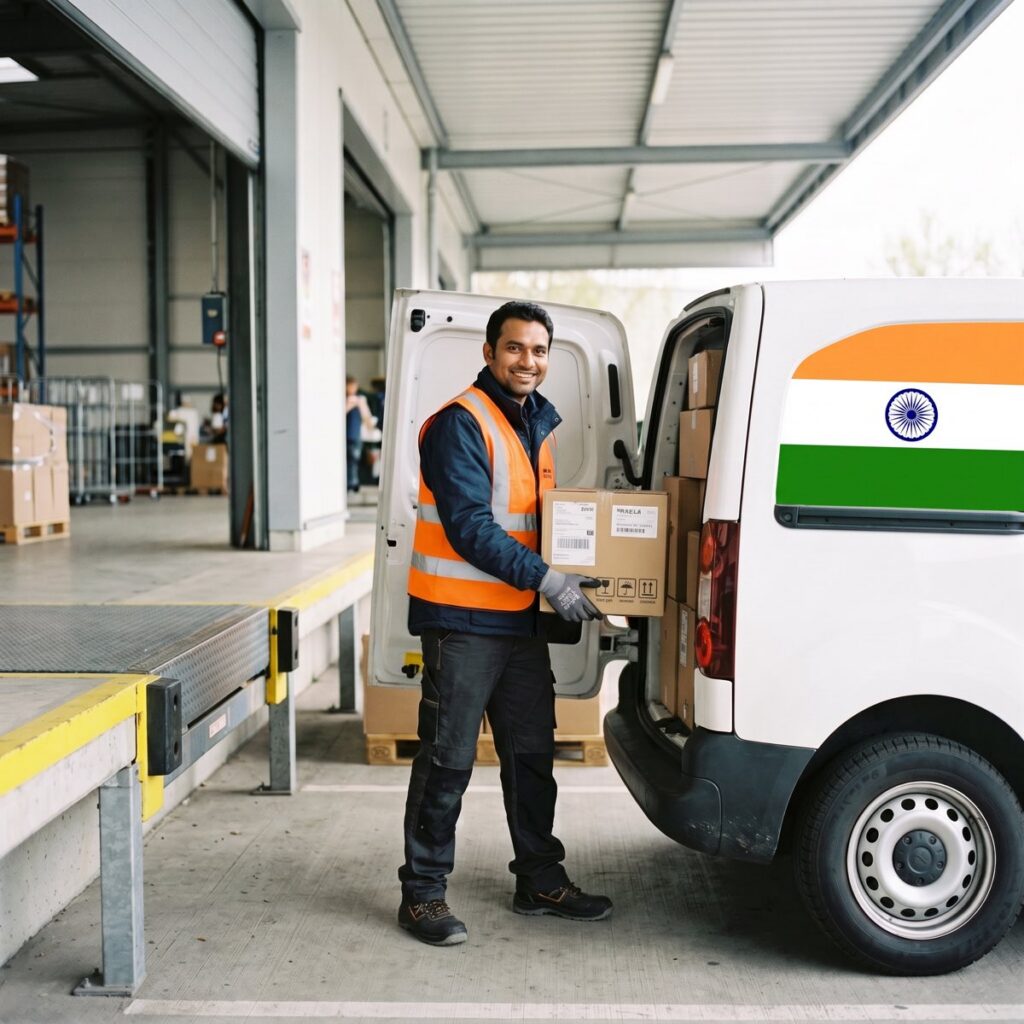
“The mother of all deals” — that’s what European Commission President Ursula von der Leyen called the agreement the EU and India sealed in New Delhi at the end of January 2026, after nearly two decades of on-again, off-again negotiations. Big words. But what do they actually mean for a mid-sized business in Lyon, Barcelona or Vienna sending machine parts, measuring instruments or medical devices to Pune or Bengaluru?
The short version: lower tariffs, less paperwork, and access to a market of over 1.4 billion people that is opening its doors wider than it has in a generation. The catch: none of that arrives automatically. The new customs advantages are tied to rules of origin, the right paperwork, and getting your shipping process in order first.
That’s what this article is about — not the diplomacy, but what changes for you as a business customer shipping goods to India, and what to do about it now.
What Is the EU–India Free Trade Agreement, Exactly?
Forget the cliché of India as purely an IT outsourcing destination. With more than 1.4 billion people and a middle class growing faster than almost anywhere else, India is now the world’s fastest-growing major economy. On 27 January 2026, the EU and India politically sealed their free trade agreement in New Delhi — the result of nearly 20 years of negotiations, pauses and restarts.
The goal is to dismantle classic tariffs as well as the slower-moving bureaucratic barriers behind them. Together, the two economic areas represent around two billion people and roughly a quarter of global economic output. For European businesses — particularly after the supply chain turbulence of recent years — this is a genuine opening to diversify beyond a handful of trading partners and reduce dependency risk.
One important caveat up front: politically agreed is not the same as legally in force. The treaty text was published at the end of February 2026, and the ratification process is under way. Entry into force is expected in early 2027 (more on the timeline in the FAQ below).
Where the Real Money Is: Tariff Cuts by Sector
Indian import duties on machinery, chemicals or car parts have long been a genuinely painful line item for European exporters — sometimes running into double digits. The agreement changes that calculation fundamentally: tariff reductions cover more than 90% of EU goods exports, while India liberalises around 96% of its tariff lines. The European Commission expects EU exports to India could double by 2032.
In practical terms: goods that used to get noticeably more expensive at the border will land more cheaply with your Indian customer — improving your margin, or your position in a price-sensitive tender against competitors from countries without an agreement. If you’re exporting to third countries more broadly, our guide on 5 tips for a smooth export from the EU to third countries covers the fundamentals.
Research- and technology-intensive sectors stand to gain the most:
| Sector | Old average tariff | New tariff under the agreement | What it means in practice for B2B |
|---|---|---|---|
| Machinery & plant engineering | 7,5 % – 15 % | 0 % (partly phased) | Direct cost savings on industrial equipment and spare parts. |
| Automotive & suppliers | up to 15 % (components) | phased down to 0% | Easier integration of Indian plants into global supply chains. |
| Medical technology | 7,5 % – 10 % | 0 % | Faster market access for high-tech hospital equipment. |
| Chemical products | 10 % – 12,5 % | 0 % | More competitive pricing on industrial intermediates. |
| Electronics & precision instruments | 7,5 % | 0 % | More cost-efficient shipping of precision equipment. |
Worth knowing: sensitive areas of European agriculture remain protected, and the EU’s strict food safety standards apply unchanged.
Rules of Origin: The Fine Print That Decides Whether You Actually Pay Less
Duty-free access is rarely handed out unconditionally in international trade — it comes with rules attached. For your shipment to qualify for the reduced preferential tariff, the goods have to meet the origin rules set out in the agreement. In simple terms: products need to be either wholly obtained in the EU, or sufficiently processed or manufactured there. Simply repackaging goods or slapping on a new label doesn’t count.
- Up to a goods value of €6,000: any exporting business can self-declare the statement of origin directly on the commercial invoice.
- Above €6,000: you need either Authorised Exporter status or a REX (Registered Exporter) registration to issue the declaration in a legally valid way.
You apply for Authorised Exporter status or a REX registration with your national customs authority. If your business regularly exports goods worth more than €6,000 to India, it’s worth setting this up early — the registration is a one-off, and it saves time on every shipment afterwards.
A ready-to-use line for your commercial invoice:
“The exporter of the products covered by this document (Authorised Exporter / REX number: […]) declares that, except where otherwise clearly indicated, these products are of preferential EU origin.”
Getting Your Customs Documents Right for India
The agreement brings genuine tailwind — but in practice, it also demands precision on your shipping paperwork. Indian customs isn’t known for its patience with errors: even small mistakes can mean costly delays at an airport or port. Our customs hub, which we update regularly, covers the basics if you have no previous experience of exporting outside the EU.
Your compact checklist for India customs documents:
- Commercial invoice: in triplicate, and it must be in English.
- HS code: at least 6 digits, ideally broken down to the full 8 digits.
- Proof of preference: the statement of origin, including your REX number, placed directly on the invoice.
- Packing list: a detailed breakdown of all packages, weights and dimensions.
Choosing a Carrier for EU–India Shipments
Not every express or freight carrier handles preferential-origin data the same way. Make it easy on yourself: on LetMeShip, you can compare rates from carriers such as DHL Express, FedEx and UPS side by side, and submit your customs documents fully digitally (paperless trade) as part of the same booking.
Compare shipping rates to India now and book straight away.
Bulk Clearance: The Efficiency Trick Most Guides Skip
Here’s the practical question most coverage of the agreement skips entirely: how do you actually book this efficiently as part of day-to-day B2B shipping? The agreement provides for concrete simplifications in express and courier shipping — and one of them is a genuine insider tip.
If your business regularly sends smaller shipments, urgent spare parts or samples to India, you can consolidate several shipments to the same recipient, or to the same logistics hub, into a single customs declaration through bulk clearance. The upside: noticeably lower fixed customs clearance fees per shipment, and less administrative work on your side. For an early estimate of the duties involved, use our customs duty calculator.
How This Deal Compares to India’s Other Trade Agreements
India isn’t new to free trade. Since 1 October 2025, the EFTA agreement (TEPA) with Switzerland, Norway, Iceland and Liechtenstein has already been in force — meaning Swiss businesses have had a head start of several months on largely duty-free exports to India. India has also recently concluded agreements with Australia, the United Arab Emirates and the United Kingdom.
The EU deal is by far the largest of the group, simply because of the trade volume involved: around €180 billion a year between the two economic areas — roughly double what the India–UK agreement covers. For European mid-sized businesses, that means one thing above all: whatever head start Swiss competitors built up through TEPA starts closing the moment the EU agreement takes effect.
A note for Swiss businesses: because Switzerland isn’t an EU member, the EU–India agreement described in this article doesn’t apply to you directly. Your business already ships under TEPA, the EFTA–India agreement in force since October 2025 — with its own, separate rules of origin and documentation requirements. Don’t wait for the EU deal; check your TEPA eligibility now.
What the Agreement Doesn’t (Yet) Cover
For all the momentum, a sober look matters too. Three points B2B shippers should keep in mind:
- Not yet in force. The agreement is politically agreed, not yet legally binding. Until ratification (expected in early 2027), current tariffs continue to apply.
- Geographical indications remain open. For protected designations of origin such as Parma ham or Champagne, no separate arrangement has been made as things stand.
- CBAM is unchanged. The EU’s carbon border adjustment mechanism continues to apply as before; no exemptions are planned for India.
None of this reduces the benefit for classic goods exports — but it helps to plan with realistic expectations rather than headline optimism.
Practical Steps to Prepare Your Business Now
The EU–India free trade agreement is more than a dry policy document — it’s an invitation for mid-sized businesses to think globally again. India and Europe are moving economically closer together, and while EFTA countries are already gathering experience through TEPA, the entire EU is now catching up.
Our advice for the practical side: check your HS codes early, clarify your Authorised Exporter or REX status, and get your shipping processes ready now. Businesses that prepare secure the customs advantages from day one, instead of playing catch-up later.
Ready to ship to India? Compare carrier rates and book your next B2B shipment to India directly through LetMeShip.
Related reading: EU–Australia Free Trade Agreement · EU-Mercosur Trade Agreement · 5 tips for a smooth export from the EU to third countries
FAQ
Häufige Fragen zum Freihandelsabkommen Indien
Does India currently have a free trade agreement with the EU?
Politically, yes — the EU and India sealed the agreement on 27 January 2026. It is not yet legally in force; ratification is under way, with entry into force expected in early 2027.
Has the India–EU trade deal been officially confirmed?
The deal is politically agreed and the treaty text was published at the end of February 2026. Formal confirmation requires ratification by the European Parliament, EU member states and India, which is currently in progress.
How will the EU–India FTA affect customs documents for business shipments?
You’ll need a valid statement of origin on your commercial invoice to claim preferential tariffs. Below €6,000 in goods value, you can self-declare; above that threshold, you need Authorised Exporter status or a REX registration.
What are the main differences between the India–EU and India–UK free trade agreements?
The EU agreement covers a far larger trade volume — around €180 billion a year, roughly double the India–UK deal — and applies across all EU member states at once. India’s agreements with the UK, Australia, the UAE and, via EFTA, Switzerland, Norway, Iceland and Liechtenstein, were each negotiated and concluded separately, with their own origin rules and timelines.
Which goods exported from the EU to India benefit most from reduced tariffs?
Machinery and plant engineering, automotive components, medical technology, chemical products, and electronics and precision instruments see the largest tariff cuts — several sectors moving from double-digit tariffs to 0%.
When will the EU–India free trade agreement be ratified?
The treaty text was published at the end of February 2026, and ratification by the EU Parliament, EU member states and India is under way. Entry into force is expected in early 2027.
Does the EU–India agreement apply to Swiss businesses?
No. Switzerland is not an EU member. Swiss businesses already trade with India under TEPA, the EFTA–India agreement in force since 1 October 2025, which has its own separate rules of origin.

Hi, I’m Eike 👋
I’m in the LetMeShip Sales team and ready to get the best rates and shipping options for you.
Let’s talk – We’re Here to Help!
Get a call back or book an appointment at your convenience.