Shipping lithium batteries and rechargeable batteries
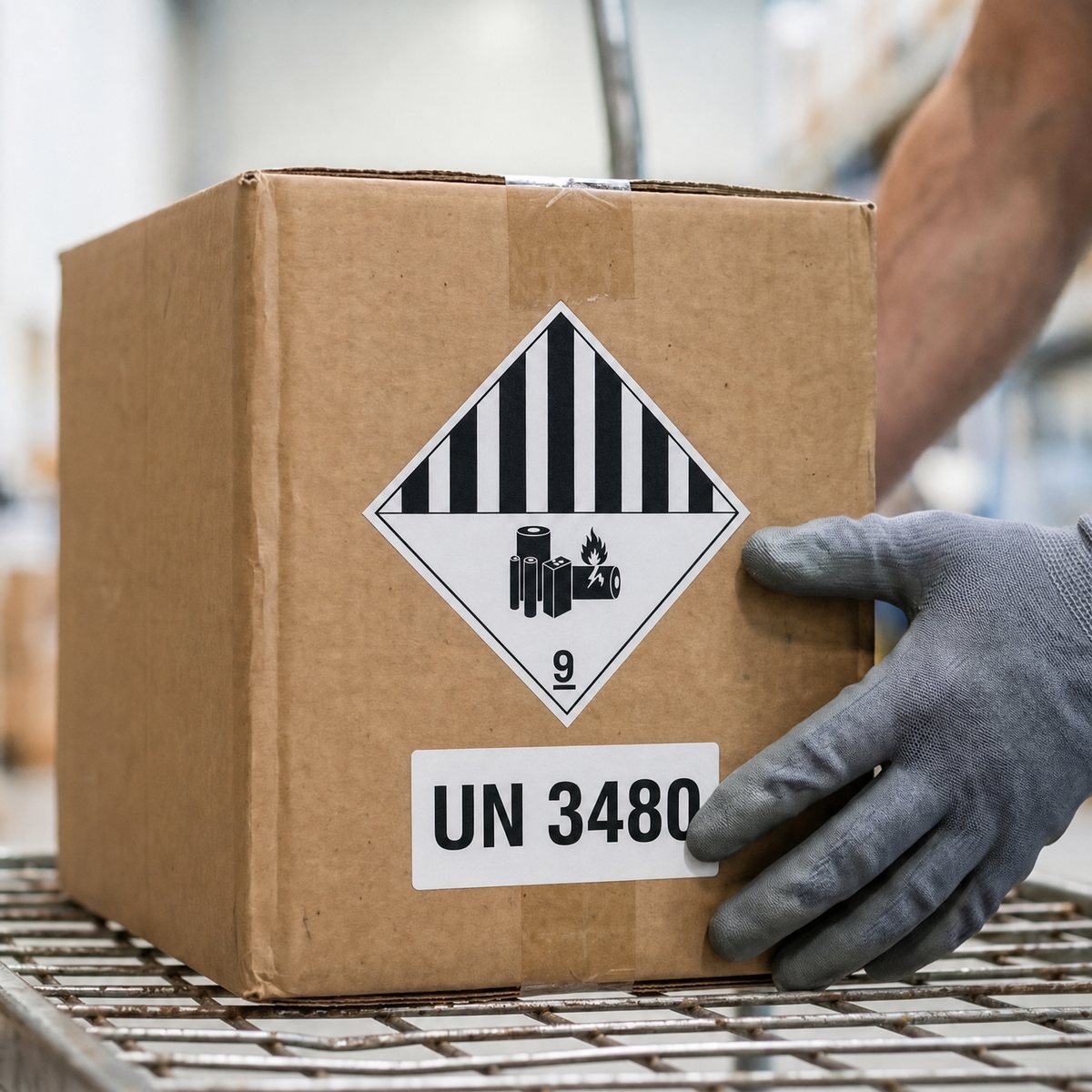
As a business, you can ship lithium batteries via LetMeShip following a one-off activation – domestically by express road delivery, and internationally by air freight. Whether it’s a loose battery under UN 3480 or a device with a built-in battery under UN 3481: we’ll give you a definitive answer during a 15-minute appointment as to what can and cannot be shipped via our platform.
You can then book your lithium shipments yourself – one account for over 20 carriers, without needing your own carrier contracts and with no contractual obligations.
Summary
Key information on shipping lithium
- Lithium batteries are Class 9a dangerous goods – four UN numbers determine the packaging and labelling requirements: UN 3480, UN 3481, UN 3090 and UN 3091.
- Shipping via LetMeShip requires authorisation. Provided the necessary conditions are met, this is arranged directly during a 15-minute appointment with our dangerous goods safety adviser.
- You need trained staff, not a designated safety adviser. Training in accordance with ADR 1.3 is required for road transport and IATA DGR 1.5 for air freight; for laptops and smartphones, training in accordance with IATA DGR 1.6 is sufficient.
- Faulty batteries are not permitted. Cells classified as defective for safety reasons are excluded from air transport – as are hoverboards and e-scooters, unless they are new and unopened.
- For business customers only. Domestic express delivery by road; international delivery by air freight. Rail, sea and inland waterway transport are excluded.
Contents: Shipping lithium
Which provider ships lithium batteries in accordance with UN 3480 and UN 3481?
The major express carriers generally accept lithium shipments – but usually only from business customers with their own dangerous goods contract. This is precisely where many shippers run into difficulties: a separate contract, a separate assessment and a separate onboarding process for each carrier.
LetMeShip provides access to these carriers via a single account. You do not need your own contractual relationship with DHL, UPS or FedEx; all you need is authorisation from us. This authorisation forms part of our dangerous goods service and, provided the necessary conditions are met, is granted immediately during the appointment – not via a form and not with a waiting period of several days.
What is required for account activation
Anyone who dispatches or prepares dangerous goods requires training in accordance with ADR 1.3 for road transport and IATA DGR 1.5 for air freight; for laptops and smartphones, training in accordance with IATA DGR 1.6 is sufficient. We require proof of training upon account activation; on request, we can put you in touch with training providers. A dangerous goods safety adviser appointed in accordance with the Dangerous Goods Safety Adviser Regulations is not required for account activation – whether your company is required to appoint one depends on your volumes and activities and is a separate matter.
UN 3480, UN 3481, UN 3090 and UN 3091: Which number applies to your consignment?
The UN number depends on two factors: Is the battery rechargeable (lithium-ion) or not (lithium metal)? And is it being shipped on its own or together with a device? This combination results in four possible numbers:
| UN number | What it refers to | Typical example | Can it be shipped via LetMeShip? |
|---|---|---|---|
| UN 3480 | Lithium-ion batteries, shipped on their own | Spare battery, power bank without device | Yes, once activated |
| UN 3481 | Lithium-ion batteries inside the device or packed with the device | Laptop, measuring device with spare battery | Yes, once activated |
| UN 3090 | Lithium metal batteries, shipped on their own | Button cell, primary lithium cell | Yes, once activated |
| UN 3091 | Lithium metal batteries contained within the device or packed with the device | Car keys, camera, thermometer | Yes, once activated |
The UN number applicable to your consignment, the shipping name and the packing instructions can be found in Section 14 of the safety data sheet. Please check this section for completeness before each booking – you will then enter the details into the booking form, and the platform will guide you through the mandatory fields. Further numbers can be found in the overview of UN numbers.
Three packaging options for lithium batteries
The key factor in classification is the relationship between the battery and the device. There are exactly three scenarios:
- Battery contained within the equipment: The battery is securely fitted inside the equipment, such as a laptop or a handheld measuring device. This is the standard case with the least stringent requirements.
- Battery packed with the device (packed with equipment): The device and spare battery are packed together in the box, but are not connected. The battery requires its own inner packaging with short-circuit protection.
- Battery only: Batteries only, no device. This is the most challenging scenario – the strictest requirements regarding packaging, labelling and documentation apply here.
In all three cases, the following applies: secure the terminals against short circuits, protect each cell individually against contact, and use only UN-compliant and undamaged packaging. If packaging is reused, old dangerous goods labels must be removed beforehand. Shipping unpackaged goods in open containers is not permitted. Information on which hazard labels and markings are required on the box can be found under Dangerous Goods Labelling and Packaging.
Lithium-ion or lithium-metal?
Lithium-ion batteries (UN 3480, UN 3481 when installed in a device) are rechargeable. They are found in laptops, power banks, e-bike batteries and power tools. Lithium metal batteries (UN 3090, UN 3091 when installed in equipment) are non-rechargeable and are used to power, amongst other things, watches, cameras, car keys and some medical devices. Both types can be shipped via LetMeShip – however, the regulations differ in terms of packaging and labelling requirements.
Shipping e-bike batteries, power banks and tool batteries
Typical customers in the lithium sector include e-bike manufacturers, power bank distributors, electronics repair services and manufacturers of tools or wearables with built-in batteries. Three scenarios are particularly common:
- E-bike batteries are heavy, have a high capacity and are frequently returned following repairs. The state of charge and the condition of the cell determine whether they can be shipped – a battery classified as defective is excluded from air transport.
- Power banks are usually shipped on their own and therefore fall under UN 3480. Each unit must have short-circuit protection and internal packaging that prevents the terminals from coming into contact with one another.
- Tool and equipment batteries are classified as UN 3481 or UN 3480, depending on the packaging. If the spare battery is placed next to the equipment in the box, it is packed with equipment – not contained in. If there are other dangerous goods inside the equipment, please refer to our page on dangerous goods in equipment and machinery.

What you cannot send via LetMeShip
So that you are aware of this before your appointment: these lithium consignments are excluded under our special terms and conditions for dangerous goods shipping bookings.
- Defective or damaged cells and batteries which, for safety reasons, have been identified as defective and pose a risk of dangerous heat generation, fire or short-circuit – including consignments covered by ADR Special Provision 376. Excluded from air transport.
- Data loggers and data monitors, with the exception of FedEx SenseAware®.
- Small battery-powered vehicles such as hoverboards, self-balancing scooters and unicycle scooters – unless they are new and in their original, unopened packaging.
- Different UN numbers in a single consignment (prohibition on mixed loading). An exception is made for the packing together of lithium batteries with different UN numbers that are exempt from the labelling requirement – such as temperature measuring devices – provided that UN 3481 in accordance with PI 967 or UN 3091 in accordance with PI 970 has not been selected in the booking platform.
- Consignments exceeding the 1,000-point limit as per ADR 1.1.3.6 for road transport. For quantities larger than groupage freight, a specialist freight forwarder is the correct option, not our platform.
- Packages bearing a carrier’s logo, as well as parcels where labels or documents are affixed to the underside.
The modes of transport are also limited: the shipment of dangerous goods by rail, sea or inland waterway is not possible via LetMeShip, not even as a multimodal solution.
Step by step: How to send lithium batteries
- Get in touch
Contact our team via our contact page. We will then arrange a 15-minute approval call with you, via video or telephone – no obligation. - Clarify requirements and get authorised
During the call, we will check your consignments and your proof of training in accordance with ADR 1.3 or IATA DGR 1.5 or 1.6. If the requirements are met, we will authorise you immediately during the appointment. - Classify, pack and label:
take the UN number from Section 14 of the safety data sheet, pack in accordance with UN regulations, secure the poles and affix the prescribed dangerous goods labels in a visible position. Enclose the safety data sheet and transport documents in full. - Book yourself:
Enter your consignment details and dangerous goods information into the platform, compare carriers and services, then book. You can see the price for your specific consignment in the booking form, without needing to make a separate enquiry.
A note on planning: For consignments of dangerous goods, the stated transit times and delivery times are not binding – even if you select a shipping method that usually has a binding delivery time. Please allow for a suitable buffer when arranging time-critical lithium consignments.
FAQ
Frequently asked questions about shipping lithium
Do I need training for UN 3481?
Yes. Anyone preparing or booking consignments of dangerous goods requires training in accordance with ADR 1.3 for road transport or IATA DGR 1.5 for air freight; for laptops and smartphones, training in accordance with IATA DGR 1.6 is sufficient. This applies to all four lithium UN numbers, including UN 3481. We require proof of training upon account activation; on request, we can arrange training providers.
Can I send a faulty battery?
Not by air freight. Cells and batteries that have been identified as defective for safety reasons and which pose a risk of dangerous heat build-up, fire or short circuit are excluded from air transport – including consignments under ADR Special Provision 376. We will clarify whether road transport is an option for your specific case during the authorisation meeting.
Can you ship lithium batteries internationally?
Yes, internationally by air freight and domestically by express road transport, in each case in compliance with ADR and IATA regulations. The shipping options available for your consignment depend on the substance class, quantity, packaging, country of origin and destination, as well as the carrier handling the shipment, and will be displayed to you on the booking platform. Rail, sea and inland waterway transport are excluded.
What is the difference between lithium-ion and lithium-metal?
Lithium-ion batteries are rechargeable and are classified as UN 3480 or UN 3481 when shipped with a device. Lithium metal batteries are non-rechargeable and are classified as UN 3090 or UN 3091. Both types can be shipped via LetMeShip, but the regulations differ in terms of packaging and labelling requirements.
Is there a quantity limit for lithium consignments?
Yes. For road transport, consignments exceeding the 1,000-point limit as per ADR 1.1.3.6 are excluded – these must be handled by a specialist haulage contractor. Below this limit, the permissible quantity depends on the UN number, packaging instructions and mode of transport. We will review your specific circumstances during the authorisation meeting.
How much does it cost to ship lithium batteries?
The price depends on weight, destination country, mode of transport and the chosen carrier. Once your account has been activated, you will see the price for your specific consignment directly in the booking form, without needing to make a separate enquiry. Prices are exclusive of VAT, for business customers. There is no contractual commitment and no minimum volume required for activation itself.