Dangerous goods classes 1 to 9 at a glance
The nine classes of dangerous goods categorise them according to the nature of the hazard they pose. There are many overviews available – this one also answers the question that really matters in day-to-day shipping: Which classes can you actually send via LetMeShip?
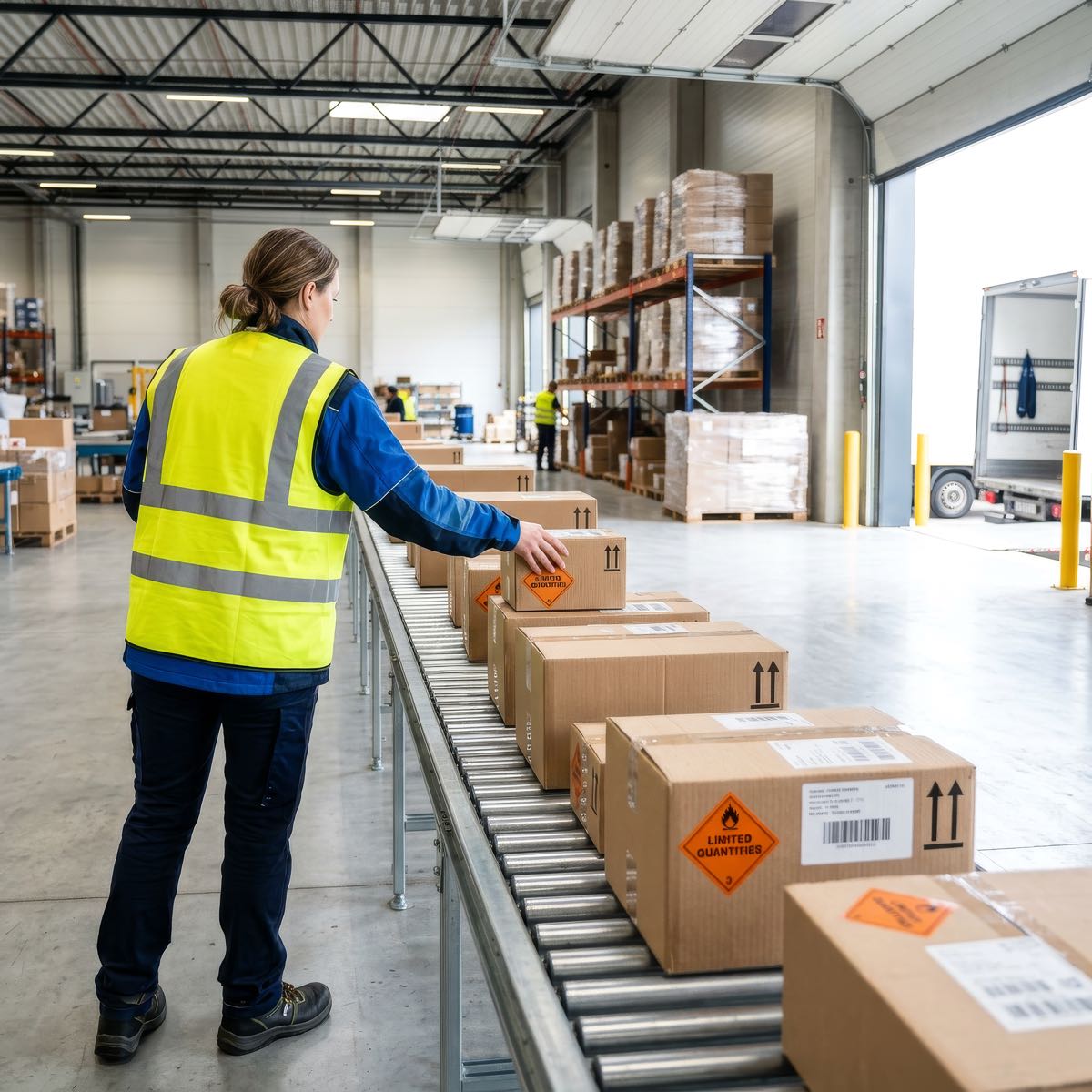
Summary
How many classes of dangerous goods are there?
There are nine classes of dangerous goods. Several of these are divided into subclasses – for example, Class 2 into flammable, non-flammable and toxic gases, or Class 6 into toxic and infectious substances. In practice, lithium batteries are often referred to as Class 9a, a subclass of Class 9.
An overview of the nine classes of dangerous goods
| Class | Description | Examples | Can it be shipped via LetMeShip? |
|---|---|---|---|
| 1 | Explosive substances and articles | Safety cartridges | Subclass 1.4S only |
| 2.1 | Flammable gases | Camping gas, lighters | Yes, with restrictions |
| 2.2 | Non-flammable, non-toxic gases | Compressed air, CO₂ cartridges | Yes, with restrictions |
| 2.3 | Toxic gases | – | No |
| 3 | Flammable liquids | Paints, varnishes, solvents | Yes, with restrictions |
| 4.1–4.3 | Flammable, self-igniting and water-reactive solids | Matches, metal powders | Yes, with restrictions |
| 5.1 / 5.2 | Substances with oxidising properties / Organic peroxides | Fertilisers, fibreglass repair kits | Yes, with restrictions |
| 6.1 | Toxic substances | – | No |
| 6.2 | Substances presenting a risk of infection | Diagnostic samples | UN 3373 only |
| 7 | Radioactive materials | – | No |
| 8 | Corrosive substances | Acids, alkalis, batteries | Yes, with restrictions |
| 9 | Various dangerous substances and articles | Dry ice, airbags, magnets, equipment containing dangerous goods | Yes, with restrictions |
| 9a | Lithium batteries | Lithium-ion, lithium metal | Yes, except for defective cells |
The information regarding shippability is taken from our Special Conditions for Dangerous Goods Shipments and applies to road and air freight once authorisation has been granted. We do not cover rail, sea or inland waterway transport. ‘Yes, restricted’ means: The class is generally permitted, but specific UN numbers are explicitly excluded.
Primary hazard, secondary hazard and packaging group
A substance may present more than one hazard. The primary hazard is decisive for classification; other properties are considered secondary hazards and are indicated by an additional hazard label. For example, a cleaning concentrate may be classified as a corrosive substance in Class 8 whilst also being flammable.
Within most classes, there is a further classification by packaging groups: I for high hazard, II for medium hazard and III for low hazard. This determines the permissible types of packaging and the quantity limits for Limited and Excepted Quantities. This classification is of practical relevance to our platform, as it helps determine whether a consignment qualifies as a Limited Quantity (LQ) or must be fully regulated.
Class 1: Explosive substances and articles
Substances and articles containing explosives, categorised into subclasses according to their degree of hazard. Via LetMeShip, this class is completely excluded from air and road transport – with one exception: subclass 1.4S, i.e. substances and articles presenting a low risk of explosion, is permitted for air and road transport.
Class 2: Gases
Class 2.1 comprises flammable gases. UN 1001 (acetylene, dissolved) is excluded; lighters are excluded from road transport unless they are consigned in accordance with 1.1.3.6 ADR. Class 2.2 comprises non-flammable, non-toxic gases – excluded from air transport in this class are UN 1072 (oxygen, compressed), UN 1070 (nitrous oxide), UN 2451 (nitrogen trifluoride), UN 3156 and UN 3157. Class 2.3, toxic gases, is entirely excluded. Spray cans, as pressurised gas containers (UN 1950), also fall under Class 2 – see Aerosols in LQ shipping for further details.
Class 3: Flammable liquids
Paints, varnishes, solvents, adhesives, alcohol-based preparations. This class is permitted via LetMeShip, but the following are excluded: UN 1162 (dimethyldichlorosilane), UN 1308 (zirconium in a flammable liquid) and substances that must be transported at elevated temperatures (UN 3256, UN 3257). In small packaging, this class is frequently shipped under the Limited Quantities scheme.
Class 4: Flammable solids
Class 4.1 comprises flammable solids, self-reactive and polymerising substances, as well as desensitised explosive substances; Class 4.2 comprises self-heating substances; and Class 4.3 comprises water-reactive substances. Substances in a molten state are excluded (UN 2304, UN 3176, UN 2448, UN 2447) and substances with a Class 1 subsidiary risk (UN 3221, UN 3222, UN 3231, UN 3232). The following also applies to Class 4.3: Consignments originating outside the USA and destined for the USA are excluded from air transport.
Class 5: Substances with oxidising properties and organic peroxides
Class 5.1 comprises substances with an oxidising effect, such as fertilisers; excluded is UN 1873 (perchloric acid), and for air transport additionally UN 3356 (oxygen generator, chemical). Class 5.2 comprises organic peroxides, such as those found in fibreglass repair kits; substances with a Class 1 subsidiary hazard are excluded (UN 3101, UN 3102, UN 3111, UN 3112).
Class 6: Toxic and infectious substances
Class 6.1, toxic substances, is completely excluded from LetMeShip. Class 6.2, infectious substances, is also excluded – with the sole exception of UN 3373 (biological substance), which is authorised for air and road transport. Please note: Substances subject to temperature control are generally excluded.
Class 7: Radioactive substances
This class is completely excluded from air and road transport via LetMeShip, without exception. This also applies to equipment containing a radioactive source – such as test or calibration sources used in measurement technology and nuclear medicine. For such consignments, you will need a specialist carrier. Important to note: Not every device that operates using radiation falls into this class. An X-ray machine generates its radiation electrically and has no residual radiation when switched off – it is therefore not classified as dangerous goods because of the radiation, but at most because of built-in components such as batteries, insulating gases or oils. The decisive factor is therefore whether the device contains a radioactive substance.
Class 8: Corrosive substances
Acids, alkalis and accumulators. Excluded are UN 2215 and UN 2576 in molten form, UN 1796 and UN 1826 (nitrous acid mixtures) and UN 2031 (nitric acid). Wet batteries classified as UN 2794 and UN 2795 are excluded from road transport – unless they fully comply with ADR Special Provision 598, the route does not include a ferry crossing, and the consignment note and packaging bear the appropriate endorsement.
Classes 9 and 9a: Miscellaneous dangerous substances
The collective class: dry ice, airbags, magnetised material, equipment containing dangerous goods and lithium batteries. Excluded are UN 2315 and UN 3432 (polychlorinated biphenyls) as well as UN 3077 and UN 3082 (environmentally hazardous substances, n.o.s.). Class 9a covers lithium batteries; specifically excluded from air transport are cells identified as defective for safety reasons, as well as data loggers and small battery-powered vehicles.
Class 9 is by far the most important class in B2B shipping – not because it is particularly dangerous, but because this is where everyday items fall into: the battery in a laptop, the magnet in a loudspeaker, the dry ice in a cool box, the residual liquid in a machine. Anyone who regularly sends electronics, appliances or spare parts is almost always dealing with Class 9 or 9a, even without realising it.
Are you sending lithium batteries, chemicals in small containers or equipment containing dangerous goods? We cover these cases in detail on our dangerous goods shipping page – where you will also find the authorisation date.
FAQ
Frequently asked questions about dangerous goods classes
How many classes of dangerous goods are there?
Nine. Several classes are further subdivided into subclasses, such as Class 2 into 2.1, 2.2 and 2.3. In practice, lithium batteries are often referred to as Class 9a, a subgroup of Class 9.
Which classes of dangerous goods can I send via LetMeShip?
Once authorised: Class 9a (lithium batteries) and, to a limited extent, Classes 2, 3, 4, 5, 8 and 9. Class 1 only as subclass 1.4S; Class 6.2 only as UN 3373. Class 2.3, Class 6.1 and Class 7 are completely excluded.
What does ‘restricted’ mean in the table?
The class is generally permitted; however, certain UN numbers are specifically excluded from transport – in some cases only for air freight, in others for both road and air. The full list can be found in our Special Conditions for Dangerous Goods Shipments.
Where can I find the class of my goods?
In the safety data sheet, Section 14. This contains the class, UN number, official shipping name and packaging group. The consignor is responsible for ensuring the correct classification of the dangerous goods.