Shipping dangerous goods as a business. We’ll get you up and running!
Contact us and we will activate dangerous goods booking for you. Personal support and no paperwork. No contract commitment and no minimum volume.
Please note: dangerous goods shipping is only available to customers in Germany and France.
26 years
of hands-on logistics expertise. We know the regulations.
3 million
shipments per year via our platform. We know what can go wrong during dispatch.
15-minute
appointment with our dangerous goods officer. Access granted after the call.
“In 15 minutes, we’ll work out together whether and how your consignments can be dispatched via LetMeShip. If the requirements are met, I’ll activate your account straight away during the call. No waiting, no need for a second appointment.”
Björn Ehrich, Dangerous Goods Safety Adviser at LetMeShip
Three steps to your first dangerous goods consignment
No endless enquiries, no days spent waiting. Provided the requirements are met, your account will be activated straight away during the 15-minute appointment.
- Get in touch: Contact us or give us a call to arrange your appointment. No registration required, no obligation.
- Clarify the details in a call with Björn Ehrich in Germany or with our French customer service agent: In 15 minutes, we’ll sort out the substances, quantities and destination countries. If everything’s in order, we’ll activate your account straight away during the call. No second call, no days’ wait.
- Get started and book yourself: in 15 minutes we’ll clarify the substances, quantities and destination countries. If everything’s in order, we’ll activate your account straight away. No need for a second call, no days’ wait.
What dangerous goods do you ship via LetMeShip?
A clear overview of the nine classes of dangerous goods: what we can handle, what we can handle subject to restrictions, and what we do not handle.
| Class | Description | Can we ship this? | Examples |
|---|---|---|---|
| 1 | Explosive substances | Class 1.4S (low risk of explosion) | Safety cartridges |
| 2.1 | Flammable gases | Yes, with restrictions | Aerosols, camping gas (excluding acetylene) |
| 2.2 | Non-flammable gases | Yes, with restrictions | Compressed air, CO₂ cartridges |
| 2.3 | Toxic gases | No | – |
| 3 | Flammable liquids | Yes, with restrictions | Paints, varnishes, solvents |
| 4.1–4.3 | Flammable solids / Spontaneously combustible / Reactive with water | Yes, with restrictions | Matches, phosphorus |
| 5.1–5.2 | Oxidising substances / Organic peroxides | Yes, with restrictions | Fertilisers, fibreglass repair kits |
| 6.1 | Toxic substances | No | – |
| 6.2 | Infectious substances | UN 3373 only | Biological samples (diagnostics) |
| 7 | Radioactive materials | No | – |
| 8 | Corrosive substances | Yes, with restrictions | Acids, alkalis, batteries |
| 9 | Miscellaneous dangerous goods | Yes, with restrictions | Dry ice, airbags, magnets |
| 9a | Lithium batteries | Yes | Lithium-ion, lithium metal (except if defective) |
Generally not possible: shipments by rail, sea freight or inland waterway; substances requiring temperature control; groupage freight by lorry (standard ADR 1,000-point limit); defective or damaged lithium batteries
→ View the full terms and conditions: Special Conditions for Dangerous Goods (PDF, as at April 2026)
We handle these dangerous goods on a daily basis
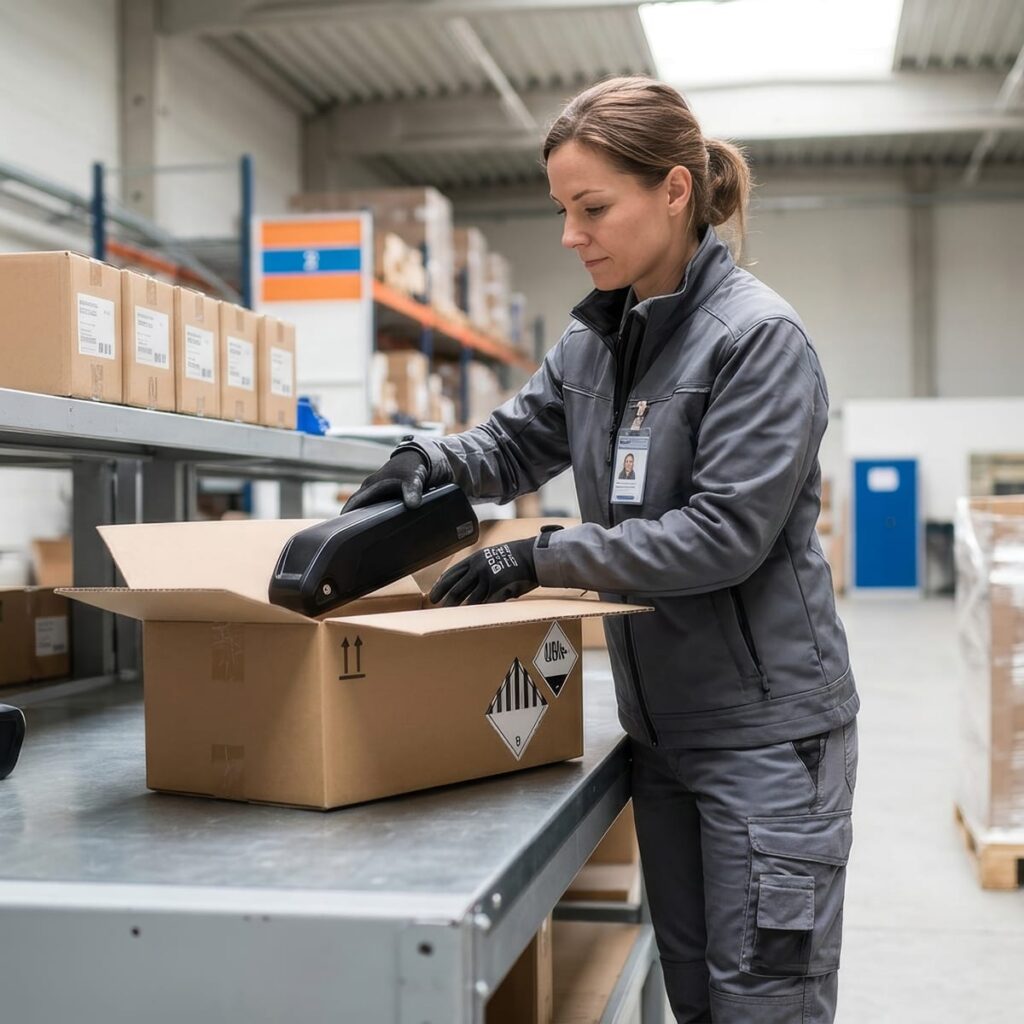
Shipping lithium batteries, power banks and e-bike batteries
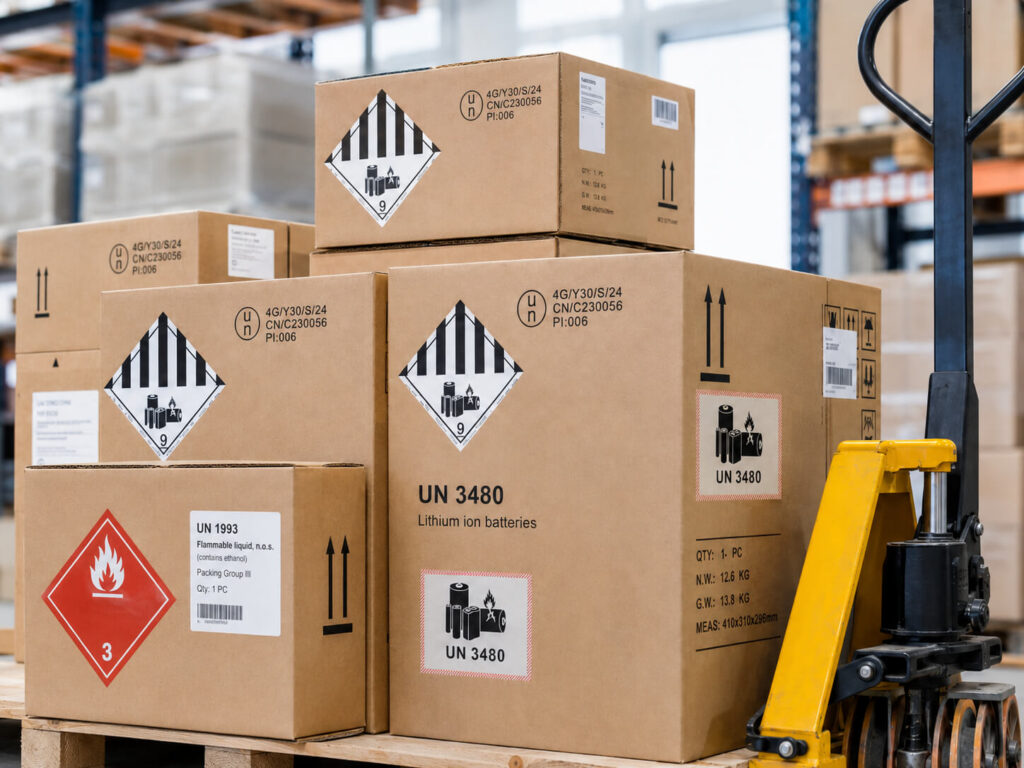
Are you sending e-bike batteries, power banks or tools with built-in batteries? Class 9a has its own rules – find out more under Sending lithium batteries. We’re familiar with them and can handle your lithium consignments nationally via express delivery and internationally by air freight.
Typical customers: e-bike manufacturers, power bank distributors, electronics repair services, and manufacturers of tools or wearables with built-in batteries.
Shipping chemicals in small containers
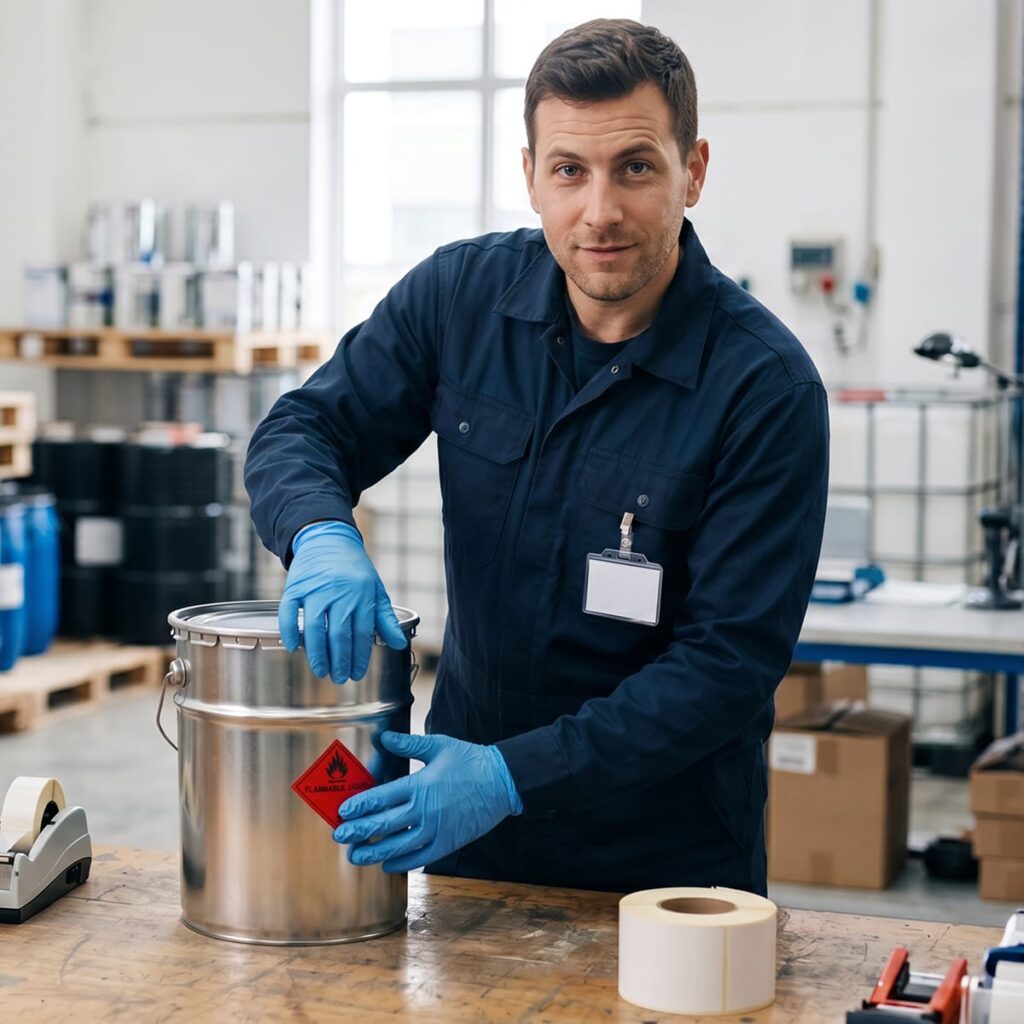
Do you ship paints, adhesives or cleaning products in small containers? You ensure UN-compliant packaging and declaration. We take care of transport, carrier selection and the required documentation. Find out more: Chemicals and paints in small containers. Typical customers: paint retailers, printing supplies suppliers, small chemical distributors, manufacturers of industrial lubricants.

Perfumes, cosmetics and aerosols in LQ shipments
Perfume, nail varnish, hairspray, deodorants? Aerosols usually fall under ‘Limited Quantities’ with simplified regulations. We’ll help you declare your goods correctly before your warehouse comes to a standstill due to labelling errors. Typical customers: perfume manufacturers, cosmetics brands, hairdressing wholesalers. Find out more: Aerosols, perfume and cosmetics in LQ shipments.

What are dangerous goods and how do you ship them?
Dangerous goods are defined as substances and articles which, during transport, may pose a risk to people, the environment, animals or property. Classification is based on internationally standardised regulations. For road transport, the ADR (Agreement concerning the International Carriage of Dangerous Goods by Road) applies; for air transport, the IATA Dangerous Goods Regulations apply. Anyone wishing to dispatch dangerous goods must comply with these regulations. Responsibility lies with the consignor.
In day-to-day business, dangerous goods cover far more products than most companies realise. Perfumes and deodorants are classified as dangerous goods, as are rechargeable batteries and lithium batteries found in smartphones, power tools or e-bikes. Printer cartridges, brake fluid, aerosols and many types of paint also fall into this category. A large proportion of consignments sent by small and medium-sized enterprises fall under dangerous goods regulations without anyone realising, until at some point a carrier rejects a consignment.
How can you identify dangerous goods?
The quickest way to find out is to check your supplier’s safety data sheet (SDS). Section 14 is dedicated to transport. If a UN number is listed there, the goods are classified as dangerous goods. On the packaging, you can recognise dangerous goods by diamond-shaped hazard labels (classes 1 to 9), packaging group information (I, II or III), the correct shipping description and, for road transport, orange warning signs.
What are the different classes of dangerous goods?
International regulations classify dangerous goods into nine main classes, some of which are further subdivided (for full details and information on what can be shipped via LetMeShip: an overview of all nine classes of dangerous goods):
- Class 1: Explosive substances and articles
- Class 2: Gases (2.1 flammable, 2.2 non-flammable/non-toxic, 2.3 toxic)
- Class 3: Flammable liquids
- Class 4: Flammable solids (4.1), self-heating substances (4.2), substances reactive with water (4.3)
- Class 5: Oxidising substances (5.1) and organic peroxides (5.2)
- Class 6: Toxic substances (6.1) and infectious substances (6.2)
- Class 7: Radioactive materials
- Class 8: Corrosive substances
- Class 9: Miscellaneous dangerous substances and articles, including Class 9a for lithium batteries and dangerous goods in equipment and machinery
Who is responsible for the shipment of dangerous goods?
Under dangerous goods legislation, the correct classification, packaging, labelling and documentation of a dangerous goods consignment is the responsibility of the consignor. Breaches may result in fines, transport bans or liability claims. Anyone wishing to dispatch or prepare dangerous goods must undergo training in accordance with ADR 1.3 for road transport and IATA DGR 1.5 for air freight; for laptops and smartphones, training in accordance with IATA DGR 1.6 is sufficient. We will request proof of training upon account activation. On request, we can put you in touch with suitable training providers. You can find out whether you also need a designated dangerous goods safety adviser on the External Dangerous Goods Safety Adviser page.
What shipping options are available for dangerous goods?
The transport of dangerous goods in Germany and France is concentrated on two modes of transport: road and air. Via LetMeShip, you can send dangerous goods domestically by express road service and internationally by air freight. Rail, sea freight and inland waterway transport cannot be arranged via our platform, not even as a multimodal solution. For groupage shipments involving large quantities exceeding the ADR 1,000-point limit, please contact a specialist freight forwarder directly.
Shipping lithium batteries: Class 9a and what you need to bear in mind
Lithium batteries fall under dangerous goods Class 9a and are subject to specific shipping regulations, both for road transport under ADR and for air freight under IATA. Due to their high energy density, they can overheat and cause fires if damaged or short-circuited. For this reason, lithium batteries are subject to stricter regulations than many other Class 9 dangerous goods. Anyone wishing to dispatch a lithium battery must be aware of the specific requirements; otherwise, carriers will refuse the consignment.
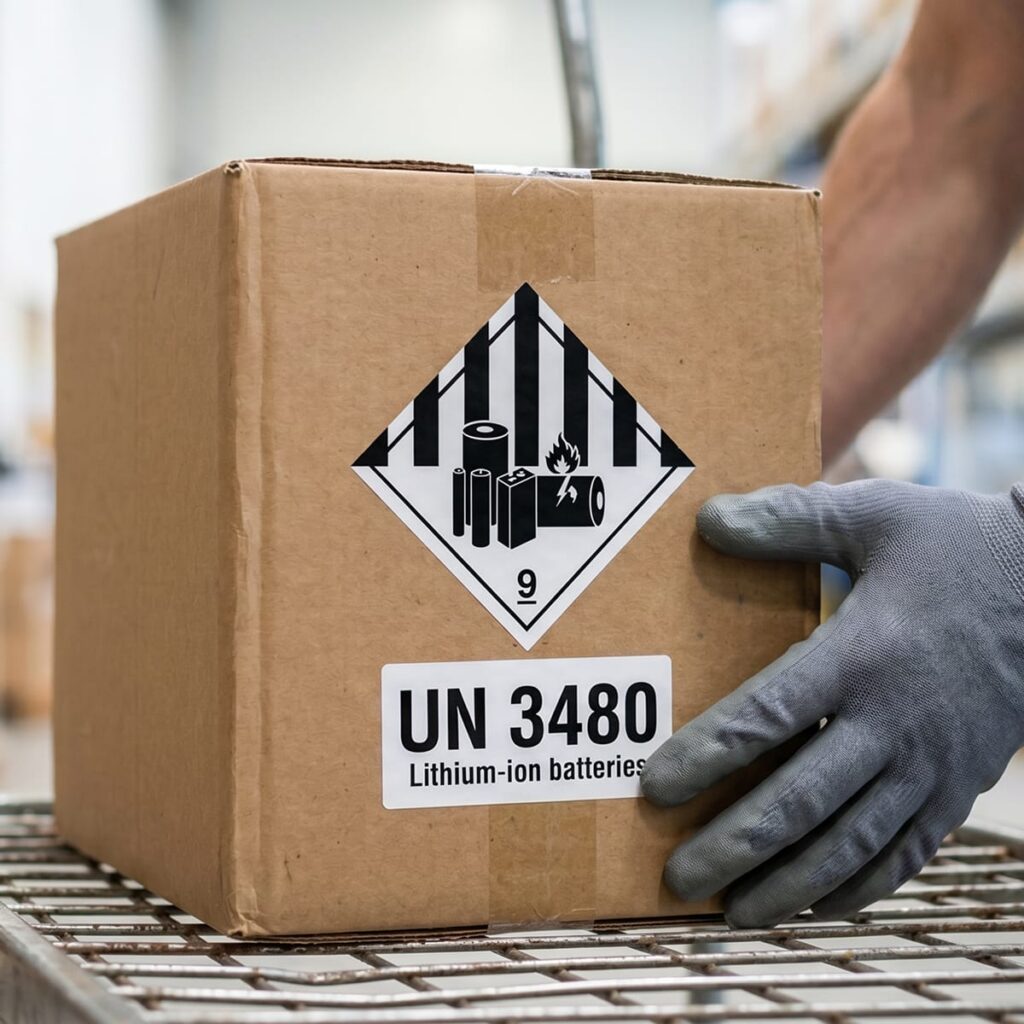
Three packaging options for lithium batteries
The shipping regulations depend on the form in which the battery is dispatched:
- Lithium battery without a device (loose): subject to full declaration requirements; full dangerous goods labelling is required
- Lithium battery packed together with a device: fully subject to declaration, but simplified handling is possible
- Lithium battery built into the device: often not subject to declaration, simplified handling
The exact classification depends on the watt-hour (Wh) rating, the lithium content in grams and the design. The safety data sheet provides all the necessary information.
Lithium-ion or lithium-metal?
Lithium-ion batteries (UN 3480, UN 3481 when installed in a device) are rechargeable. They are found in smartphones, laptops, power banks, e-bike batteries and power tools. Lithium metal batteries (UN 3090, UN 3091 when installed in a device) are not rechargeable. They power, amongst other things, watches, cameras, car keys and some medical devices. Both types can be shipped. However, the regulations differ in terms of packaging and labelling requirements.
Which lithium batteries are you permitted to send via LetMeShip?
Once your account has been activated, you can use LetMeShip to dispatch lithium batteries in all three configurations: loose, packed with a device or installed in a device. Items excluded from dispatch include, amongst others, batteries identified as defective and posing a risk of heat generation, consignments subject to ADR Special Provision 376, data loggers (with the exception of certain models approved by the carrier) and small battery-powered vehicles such as hoverboards or unicycles (unless they are new and in their original, unopened packaging).
How do you ship lithium batteries safely?
Use only UN-compliant packaging that is undamaged. Affix the prescribed dangerous goods labels in a visible position. Include the complete safety data sheet and transport documents. Ensure that staff preparing lithium consignments have completed training in accordance with ADR 1.3 or IATA DGR 1.5 – for laptops and smartphones, training in accordance with IATA DGR 1.6 is sufficient. Once your account has been activated, LetMeShip will guide you step-by-step through all the mandatory fields in the booking process.
Limited Quantities (LQ) and Excepted Quantities (EQ): the regulations for small quantities
Not all dangerous goods are transported under the highest regulatory category. For smaller quantities per consignment, the ADR (Chapter 3.4) and the IATA Dangerous Goods Regulations (Section 2.6) provide for simplified regulations: ‘Limited Quantities’ (LQ) and ‘Excepted Quantities’ (EQ). Anyone who is familiar with these regulations and applies them correctly can dispatch aerosols, perfume and many other dangerous goods with significantly less effort.
What are Limited Quantities (LQ)?
Limited Quantities (LQ for short) refer to limited quantities of a dangerous good per inner packaging and consignment. Provided the limits are adhered to, many of the otherwise mandatory regulations apply only to a limited extent. Packages are marked with a distinctive black-and-white diamond symbol, the LQ symbol. Typical examples include perfume bottles in shipping cartons, nail varnish in make-up sets or small containers of cleaning products in e-commerce parcels. Quantity limits per UN number are set out in column 7a of ADR Table A.
What are Excepted Quantities (EQ)?
Excepted Quantities (EQ for short) allow even smaller quantities per inner packaging with further simplified regulations, typically in the millilitre or milligram range. The EQ regulation is primarily used in research, laboratories and the pharmaceutical industry: small reagent samples, micro-quantities of chemicals for testing, and pharmaceutical reference samples. Transport documents are not required in most EQ cases.
Comparison of LQ, EQ and fully regulated shipping
Excepted Quantities (EQ for short) allow even smaller quantities per inner packaging with further simplified regulations, typically in the millilitre or milligram range. The EQ regulation is primarily used in research, laboratories and the pharmaceutical industry: small reagent samples, micro-quantities of chemicals for testing, and pharmaceutical reference samples. Transport documents are not required in most EQ cases.
| Criterion | Fully regulated | LQ | EQ |
|---|---|---|---|
| Typical quantities | Large quantities | Limited quantities per parcel | Very small quantities |
| Regulations | Complete | Partially simplified | Greatly simplified |
| Labelling | Complete dangerous goods labels | LQ symbol | EQ symbol |
| Documentation | Transport document required | Partially required | Usually not required |
| Typical use case | Industry, Chemicals | Retail, e-commerce, cosmetics | Laboratory, Research, Pharmaceuticals |
How can you tell whether your consignment is LQ or EQ compliant?
The simplest source is your supplier’s safety data sheet (SDS), under section 14. There you will find the UN number, the correct shipping name, the class and the packing group. This information indicates whether LQ or EQ applies and what quantity limits are in force. If in doubt, our dangerous goods safety adviser will clarify this for you in a 15-minute consultation, free of charge.
FAQ
Frequently asked questions about the shipment of dangerous goods
How long does the activation process actually take?
If all requirements are met, our dangerous goods safety adviser will authorise you directly during the 15-minute appointment. If proof of training or other documents need to be submitted at a later date, this usually takes a few working days.
What dangerous goods can I send via LetMeShip?
You can dispatch Class 9a lithium batteries, as well as restricted quantities of Classes 2.1, 2.2, 3, 4.1, 4.2, 4.3, 5.1, 5.2, 8 and 9, domestically by express delivery and internationally by air freight. Classes 2.3, 6.1, 7, as well as temperature-sensitive substances and groupage lorry shipments, are excluded.
How much does it cost to ship dangerous goods?
The cost comprises the carrier’s standard rate and a dangerous goods surcharge. For example, a lithium battery consignment from Germany to France (approx. 2 kg) typically costs between 40 and 90 euros, depending on the service level and carrier. Once your account has been activated, you will see the final price for your specific consignment directly in the booking form, without needing to make a separate enquiry. Prices exclude VAT; for business customers only.
Do my staff need training?
Yes. Anyone preparing or booking consignments of dangerous goods requires training in accordance with ADR 1.3 for road transport or IATA DGR 1.5 for air freight; for laptops and smartphones, training in accordance with IATA DGR 1.6 is sufficient. We require proof of training when activating your account. On request, we can put you in touch with training providers.
Who is liable for errors in the declaration or labelling?
Under dangerous goods legislation, the correct classification, packaging and labelling are the responsibility of the consignor. LetMeShip and the relevant carrier undertake to ensure safe transport in accordance with the booking. Details are set out in our Special Conditions for Dangerous Goods.
Which carriers does LetMeShip use for the shipment of dangerous goods?
We work with established carrier partners, all of whom comply with ADR and IATA DGR regulations. Domestically, dangerous goods are dispatched via express service; internationally, by air freight. Which specific carrier will handle your consignment depends on the substance, quantity and destination country, and will be clarified at the time of authorisation. As a rule, your dangerous goods will be transported by FedEx.
What is the difference between LQ and EQ?
Limited Quantities (LQ, Chapter 3.4 of the ADR) allow for simplified regulations for limited quantities per package, typically in retail and e-commerce. Excepted Quantities (EQ, Chapter 3.5 ADR) apply to very small quantities with heavily simplified rules, typically in laboratory and research settings.
How long does delivery take?
For dangerous goods consignments, the delivery times quoted are indicative and not guaranteed. This is stipulated by dangerous goods legislation. Based on experience: for domestic express deliveries, usually the next working day; for international deliveries, 1 to 5 working days depending on the service and destination country.
Can you ship lithium batteries internationally?
Yes, within Class 9a. Provided that: they are undamaged, not subject to ADR Special Provision 376, and correctly packaged. Special rules apply to data loggers and small battery-powered vehicles; it is best to contact us directly.
What happens if my dangerous goods consignment turns out not to be shippable after all?
During the activation appointment, we will clarify whether your consignments can, in principle, be handled via LetMeShip. Should a specific individual consignment not be accepted after authorisation, you will see this in the booking form and can either select a standard carrier route or contact us.
Can I send dangerous goods without a LetMeShip account?
No. The dangerous goods service is linked to an activated LetMeShip Enterprise account. The account itself is free of charge and comes with no contractual commitment. The dangerous goods function is activated following the appointment.
Where can I find the legal basis?
Our full special terms and conditions for dangerous goods shipments (as at April 2026) are available as a PDF via a link on our Terms and Conditions page. In addition, the LetMeShip Terms and Conditions and the General Terms and Conditions of Business and Insurance of the respective sub-carrier (carrier) apply. You can see which carrier is being used in the booking form.