Dangerous goods labelling and packaging
This page deals with the labelling of consignments – that is, parcels and pallets that you send as a business. It does not cover orange warning signs on lorries or vehicle labelling in accordance with ADR: these are matters for haulage contractors with their own fleet.
What needs to be included on the consignment, what packaging is permitted and what documentation is required – presented concisely and including the specific exclusions that apply with us.
Summary
Key information on the labelling of dangerous goods
- The consignment must bear hazard labels indicating the relevant class, UN number, official shipping name and – in the case of liquid contents – orientation arrows.
- Only UN-compliant, undamaged packaging. No unpackaged shipments in open containers such as jerry cans, and any old labels must be removed if the packaging is reused.
- Labels must not appear on the underside. The sole exception is the UN marking on the packaging itself.
- Handwritten consignor’s declarations will not be accepted. Nine fields must be completed in block capitals.
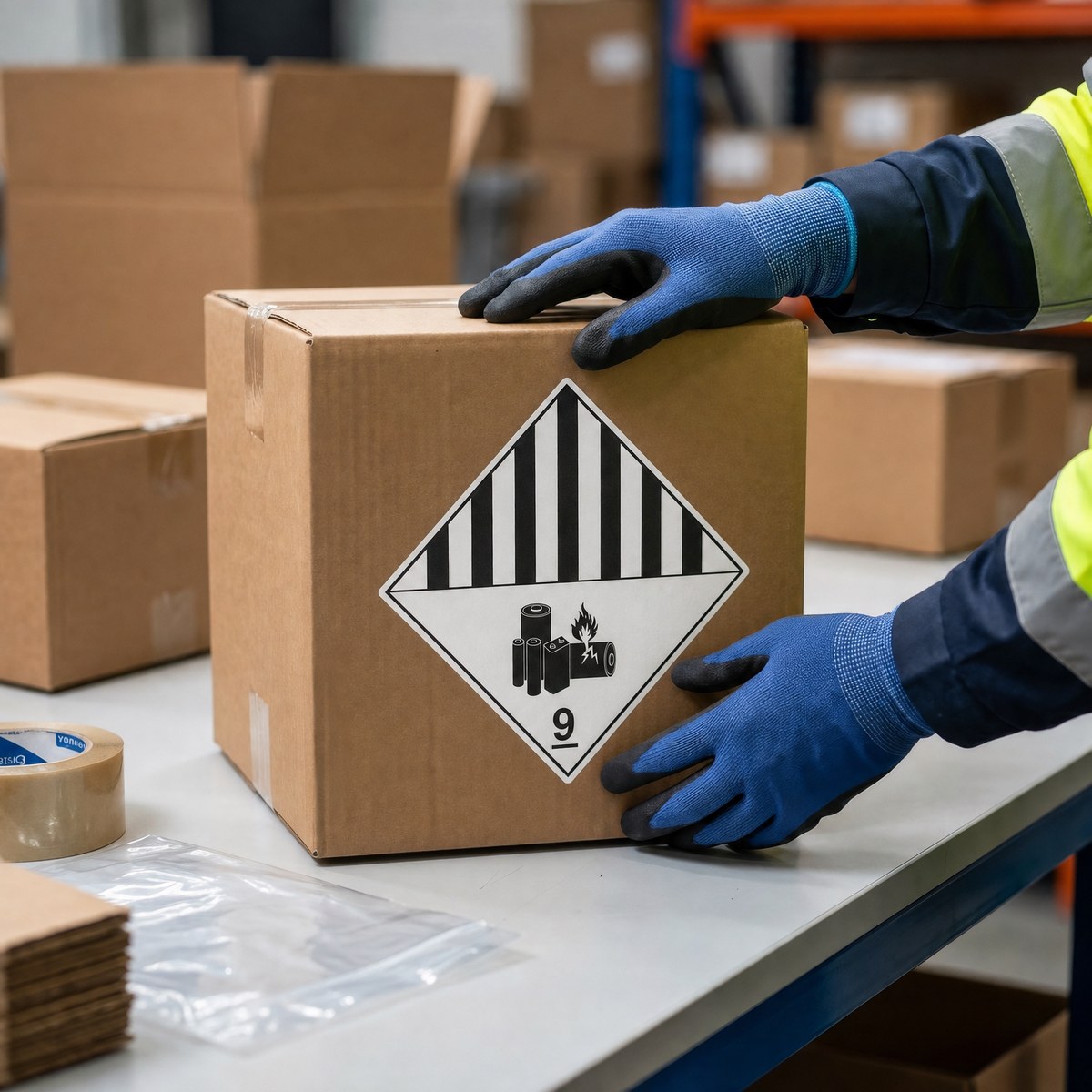
What must be displayed on a dangerous goods consignment?
The labelling of a consignment follows a simple logic: whoever handles the parcel must be able to recognise at a glance the hazard it poses and how to handle it. This applies to everyone in the chain – from the warehouse staff to the driver and the person sorting the parcel at the sorting centre. This is precisely why the guidelines are so formal: they must work without prior knowledge and without the need for further enquiries.
Specifically, a dangerous goods consignment must contain:
- Hazard labels for the relevant class; for subsidiary hazards, the corresponding label must also be included
- UN number with the prefix ‘UN’ and the official shipping description
- Orientation arrows where the consignment contains liquid dangerous goods and must be transported in a single orientation only – typically the case for equipment and machinery
- Sender and recipient addresses, stuck directly onto the parcel
- For LQ and EQ consignments, use the relevant LQ or EQ marking instead of the full dangerous goods marking
The consignor is responsible for the correct and permanent labelling and marking of all consignments. An important formal requirement: required documents, markings and labels must not be affixed to the underside of the parcel. The sole exception to this is the UN marking on the packaging itself.
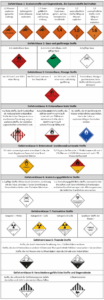
Hazard labels by class
Each class of dangerous goods has its own hazard label – an upright diamond featuring a symbol, colour and class number. The class applicable to your goods is specified in the safety data sheet, Section 14. If the substance has a secondary hazard, the corresponding second hazard label is added – without a class number, as only the primary hazard determines the classification. The labels must be permanently affixed, clearly visible and must not overlap one another.
You can find an overview of all classes, with examples and a column showing whether they can be shipped via our platform, under Dangerous Goods Classes at a Glance; details of how shipping via LetMeShip works can be found on the Dangerous Goods Shipping page.
UN-compliant packaging
Dangerous goods must be packed securely for transport. You must only use UN-compliant packaging that is undamaged, suitable for the goods to be transported and approved for that purpose. Shipping unpackaged goods – for example, in open containers such as jerry cans – is not permitted.
- Load-bearing capacity: The packaging must withstand the expected mechanical stresses during transport. It must not tear, burst or become damaged, nor must it cause any disruption to the automated or manual handling process.
- Reuse: Where permitted, packaging must be cleared of old dangerous goods labels and markings before being reused.
- Orientation: Consignments containing liquid dangerous goods that may only be transported in a specific orientation – such as machinery, equipment or containers – are marked with orientation arrows.
What LetMeShip does not accept
These points will result in the consignment being rejected, regardless of the dangerous goods class. They are set out in our Special Conditions for Dangerous Goods Shipments and are the most common reason for avoidable returns:
- Markings on the underside: Parcels on which the required documents, markings or labels are affixed to the underside – excluding the UN marking on the packaging.
- Carrier packaging: dangerous goods packed in packaging bearing the logo of the carrier responsible for the shipment.
- Prohibition on mixed loading: dangerous goods with different UN numbers packed together in a single consignment or outer packaging. An exception is made for the packing together of lithium batteries with different UN numbers that are exempt from the labelling requirement under 7.1.5.5 of the IATA DGR – for example, in temperature measuring devices.
- Dry ice without full labelling: Consignments containing dry ice require specialised packaging, the Class 9 hazard label, external marking showing the UN number, shipping description and net weight in kilograms, as well as the relevant details on the consignment note.
- Above the 1,000-point limit: dangerous goods transported by road that exceed the maximum quantities specified in ADR 1.1.3.6.
- Temperature control: Substances subject to temperature control are generally excluded, regardless of their class.
Transport documents and consignor’s declaration
All information and accompanying documents required by law and under the terms of the contract must be enclosed with the consignment in full, legibly and in the prescribed form – in particular, dangerous goods declarations, up-to-date safety data sheets in the required language, emergency information, consignment notes and customs documents.
Handwritten consignor declarations will not be accepted. These fields must be completed in typewritten or computer-generated text:
- UN or ID number, including prefix
- Correct shipping description
- Hazard class or subclass
- Secondary hazards or subclasses
- Packaging group, packaging type and packaging instructions
- Authorisation and emergency contact number
All other details, including the technical description, may be entered by hand. For air freight consignments, three copies must be submitted at the point of departure; at least two of these must feature diagonal hatching vertically along the left and right margins and be printed in red. If the consignment consists of more than one outer or secondary packaging, an additional black-and-white copy must be provided. For road transport, two copies must be provided at the point of origin.
LQ and EQ labelling
If you are shipping within the limits of restricted or limited quantities, the labelling changes: Instead of a hazard label, UN number and shipping description, the consignment bears the LQ mark in accordance with Chapter 3.4 of the ADR or the EQ mark in accordance with Chapter 3.5 of the ADR and Section 2.6 of the IATA DGR. The LQ mark is a square placed on its corner, black at the top and bottom, with a white centre. The EQ mark is an upright square with a hatched border and also includes the class number.
Important: Anyone using the LQ marking without actually complying with the limits is dispatching incorrectly declared dangerous goods – with all the associated liability consequences. We explain which quantity limits apply under Aerosols, perfumes and cosmetics in LQ shipments.
Who is responsible for labelling?
The consignor. They are responsible for ensuring the correct classification of the dangerous goods, ensuring that all packages are properly and permanently labelled and marked, and providing LetMeShip and the selected carrier with accurate and complete information during the booking process. This includes the dangerous goods class, description, UN number, packing group, the tunnel restriction code where applicable, the quantity per consignment, the total quantity and the gross weight.
It also ensures that only trained staff with a valid training certificate can make bookings. Our page on External Dangerous Goods Safety Advisers explains when an appointed dangerous goods safety adviser is also required. Breaches may result in fines, transport suspensions or liability consequences; in the event of breaches of the special conditions, LetMeShip may temporarily or permanently exclude a client from shipping dangerous goods via the platform.
FAQ
Frequently asked questions about the labelling of dangerous goods
What is a hazard label?
A hazard label is the square label affixed to the top of the consignment. It indicates the hazard posed by the contents via a symbol, colour and class number. Not to be confused with the orange warning sign affixed to the vehicle.
Can I reuse a cardboard box?
Where the reuse of packaging is permitted, yes – but it must first be cleared of all old dangerous goods labels and markings and must be undamaged. Packaging bearing a carrier’s logo must not be used for dangerous goods.
Do I need a warning label for my parcel?
No. Orange warning signs relate to the marking of vehicles and transport units, not to individual consignments. As the sender, you are responsible for marking the parcel or pallet – the carrier is responsible for marking the vehicle.
When do I need alignment arrows?
If the consignment contains liquid dangerous goods and may only be transported in a specific orientation.